Abyssal cusk-eel
Scientific name: Abyssobrotula galatheae
The Abyssal cusk-eel is a sea creature that lives in open water at depths of about 3,110–7,965 m, growing to about 17 cm. In Abyss Dive you meet it at 7,400 m, in the Hadal Zone (Hadalpelagic).
- Depth range
- about 3,110–7,965 m
- Max size
- about 17 cm
- Zone in this guide
- Hadal Zone 6,000–10,935 m
- Bioluminescence
- No
- Habitat
- Open water (swimming)
- Depth in the 3D dive
- 7,400 m
What is it?
A small cusk-eel that lives from the abyssal plain down into the trenches. It was once thought to have been caught at about 8,370 m and was known as the 'deepest-living fish'.
Did you know?
A ship's logbook error was later found, and the real collection depth was corrected to about 7,965 m. It's now counted as the third-deepest fish ever caught.
What it looks like
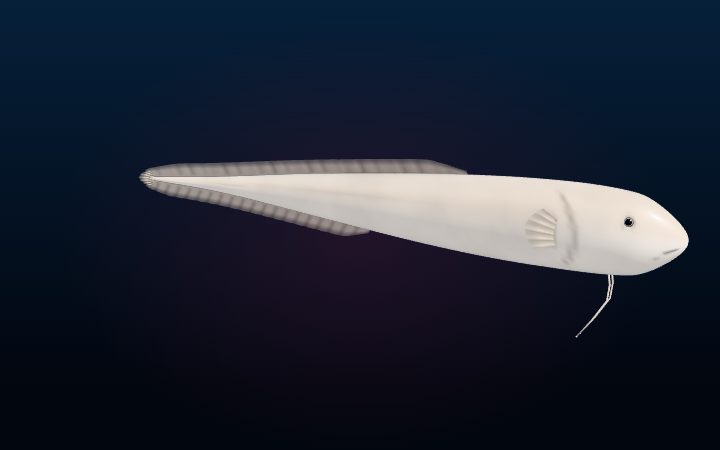
A pale apricot-colored body about 16 cm long, tapering toward the rear, dorsal and anal fins joined to the tail in one band, small eyes, and thread-like pelvic fins under the chin
More about this creature
Where and how deep it lives
It is known from deep tropical and subtropical waters of all oceans but is uncommon; three specimens have been recorded from the Gulf of Guinea. Its depth range is about 3,110–7,965 m, from abyssal plains into trenches. It appears to live mainly near the bottom, though one individual was caught up in the water column in the Gulf of Panama.
Food and hunting
It eats polychaete worms and small crustaceans such as isopods and amphipods.
Body and adaptations
The head is short and bent downward, with a swollen snout. The eyes are tiny, deep-set and hidden, and probably do not work; instead the head carries a well-developed system of sensory pores. The long pectoral fins have 10–11 rays, and the long dorsal and anal fins have 97–116 and 76–96 rays.
Its skeleton is well ossified, which fits a bottom-living life. It is yellowish, with a black gill cavity and a dark brown lining to the body cavity. The largest recorded specimen is about 16.5 cm standard length.
Life cycle and behaviour
It appears to lay eggs, and as in other members of its family they may float in a gelatinous mass, but this has not been confirmed. FishBase estimates medium resilience, with a population doubling time of about 1.4–4.4 years.
Humans and conservation
It was first misidentified as Bassogigas profundissimus and then described as a new species in 1977 by Jørgen G. Nielsen. The species name comes from the Danish naval research ship HDMS Galathea, which caught the first specimens. The depth record rested on a specimen trawled in the Puerto Rico Trench in 1970, but because the net did not close, some researchers have suggested it may have been caught shallower. It has no fisheries value, and the IUCN Red List assessed it in 2014 as Least Concern.
Sources & further reading
- Abyssobrotula galatheae — FishBase www.fishbase.se
- Abyssobrotula galatheae — Wikipedia en.wikipedia.org