Hadal sea anemone
Scientific name: Galatheanthemum sp.
The Hadal sea anemone is a sea creature that lives near the seafloor at depths of about 5,900–10,700 m, growing to about 25 cm. In Abyss Dive you meet it at 9,460 m, in the Hadal Zone (Hadalpelagic).
- Depth range
- about 5,900–10,700 m
- Max size
- about 25 cm
- Zone in this guide
- Hadal Zone 6,000–10,935 m
- Bioluminescence
- No
- Habitat
- Near the seafloor
- Depth in the 3D dive
- 9,460 m
What is it?
A group of sea anemones found only in hadal trenches, known from about 5,900–10,700 m. In 2020, a specimen about 25 cm long was collected at about 9,462 m in the Mariana Trench.
Did you know?
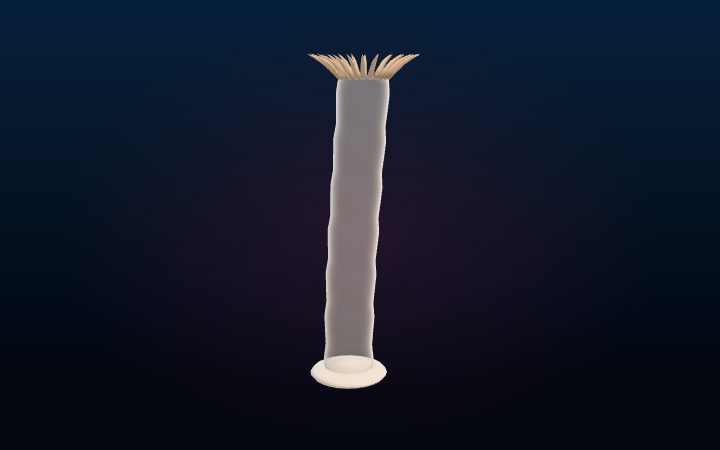
Rather than the broad disc of a typical sea anemone, it's a long column wrapped in a thin skin (a cuticle).
What it looks like
A thin, long, cylindrical column about 25 cm tall rising from the bottom (flat at both ends), pale beige and wrapped in a translucent sheath, with a ring of short tentacles at the top
More about this creature
Where and how deep it lives
The genus Galatheanthemum contains two accepted species, G. hadale and G. profundale. G. hadale is known from the Philippine Trench, while the type specimens of G. profundale came from New Zealand's exclusive economic zone, and it has since been collected from Antarctica, off Chile and around Puerto Rico and the British Virgin Islands. The World Register of Marine Species lists 45 specimens of this species held in several museums.
Body and adaptations
The body is a long column of about 25 cm with simply flattened ends, lacking the disc-like structure of typical anemones. Its surface may be covered by a layer of mucus containing many spirocysts, a type of stinging capsule.
The mitochondrial genome sequenced from a 2020 Mariana Trench specimen is about 16,633 base pairs long, the second smallest of any sea anemone sequenced so far. It contains 13 protein-coding genes, 2 ribosomal RNA genes and 2 transfer RNA genes, in the gene order shared by most sea anemones. Deep-living anemones showed a higher share of the amino acid valine, which the authors suggested may relate to coping with pressure.
Humans and conservation
Carlgren described the genus and both species in 1956, and the family Galatheanthemidae contains only this genus. A specimen collected at about 9,462 m in October 2020 by the Chinese crewed submersible Fendouzhe was fixed in 75% ethanol for study, and its mitochondrial genome was published in Frontiers in Genetics in 2022. Its feeding and reproduction have never been directly observed.
Sources & further reading
- Galatheanthemum sp. MT-2020 mitochondrial genome — Frontiers in Genetics www.frontiersin.org
- Galatheanthemum profundale Carlgren, 1956 — WoRMS www.marinespecies.org
- Galatheanthemum hadale — SeaLifeBase www.sealifebase.se