Kermadec snailfish
Scientific name: Notoliparis kermadecensis
The Kermadec snailfish is a sea creature that lives in open water at depths of about 5,879–7,669 m, growing to about 26 cm. In Abyss Dive you meet it at 6,900 m, in the Hadal Zone (Hadalpelagic).
- Depth range
- about 5,879–7,669 m
- Max size
- about 26 cm
- Zone in this guide
- Hadal Zone 6,000–10,935 m
- Bioluminescence
- No
- Habitat
- Open water (swimming)
- Depth in the 3D dive
- 6,900 m
What is it?
A snailfish found only in the Kermadec Trench in the southwest Pacific. At about 6,500–7,500 m it's abundant enough to be a common sight.
Did you know?
Its scaleless, soft body holds together under crushing pressure. Each hadal trench has its own snailfish species found nowhere else.
What it looks like
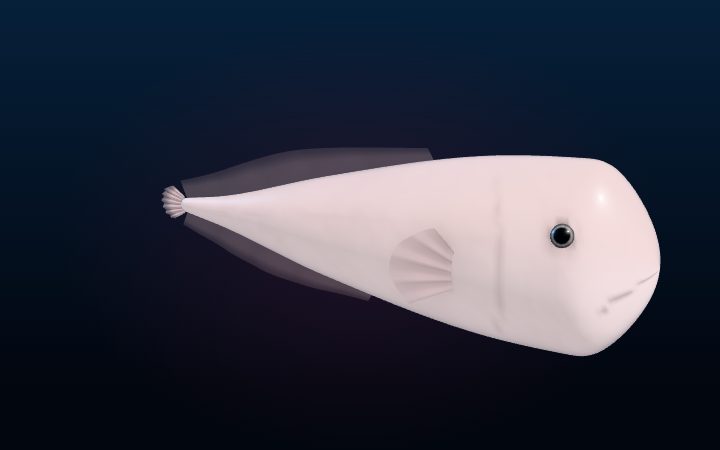
A tadpole-shaped, translucent pinkish body about 25 cm long (no scales), a round head tapering to a flat rear, dorsal and anal fins joined to the tail in one band, and small eyes
More about this creature
Where and how deep it lives
It has been recorded at about 5,879–7,669 m, and FishBase describes it as abundant at about 6,456–7,554 m. A 2016 study reported this bottom-associated species at about 6,474–7,561 m. There are indications that its larvae may spend time in open water shallower than 1,000 m. In the Southern Hemisphere, the only fish recorded deeper is Echiodon neotes, at about 8,200–8,300 m.
Food and hunting
It feeds on small shrimp-like scavengers, the amphipods that eat dead fish and other debris settling on the bottom. When it was filmed in 2009, about a dozen snailfish gathered around bait hung beneath the camera. Adult supergiant amphipods (Alicella gigantea) living in the same trench, however, are too large for it to eat.
Body and adaptations
The body is long and laterally compressed, and the largest recorded specimen is a female of about 25.8 cm standard length. The head is about 17–21% of body length, while the eye is only about 1.5–1.8%. Counts of 57–61 dorsal rays, 49–54 anal rays and 63–68 vertebrae separate it from other species in its genus.
In a 2022 study of hadal fish gut microbes, seven fish caught at about 6,456–7,515 m had communities dominated by a few lineages (the top ten types made up more than 75%), including a Moritella type related to pressure-adapted bacteria.
Life cycle and behaviour
Little is known of its life history or breeding. It closely resembles the snailfish of the Japan Trench and is thought to share a common ancestor with it, but the two trenches are thousands of kilometres apart and the fish appear unable to travel between them. FishBase estimates medium resilience, with a population doubling time of about 1.4–4.4 years.
Humans and conservation
Nielsen described it in 1964, and as of 2009 the only specimen was one caught by the Danish Galathea expedition in 1952. It was first photographed in 2007 at about 6,900 m, and in 2009 the sixth expedition of HADEEP, a joint project of the University of Aberdeen and the University of Tokyo, filmed a group at about 7,561 m, then the deepest fish record in the Southern Hemisphere. A redescription of the species was published in 2016. It has not been evaluated by the IUCN.
Sources & further reading
- Notoliparis kermadecensis — FishBase www.fishbase.se
- Deepest-dwelling fish in Southern Hemisphere photographed (2009) — NZ Herald nzherald.co.nz
- Notoliparis kermadecensis — Wikipedia en.wikipedia.org
- Microbiomes of Hadal Fishes across Trench Habitats (Blanton et al. 2022) — mSphere / PMC pmc.ncbi.nlm.nih.gov