Plastic amphipod
Scientific name: Eurythenes plasticus
The Plastic amphipod is a sea creature that lives in open water at depths of about 6,010–6,949 m, growing to about 5 cm. In Abyss Dive you meet it at 6,400 m, in the Hadal Zone (Hadalpelagic).
- Depth range
- about 6,010–6,949 m
- Max size
- about 5 cm
- Zone in this guide
- Hadal Zone 6,000–10,935 m
- Bioluminescence
- No
- Habitat
- Open water (swimming)
- Depth in the 3D dive
- 6,400 m
What is it?
An amphipod caught in baited traps at about 6,010–6,949 m in the Mariana Trench in 2014 and reported as a new species in 2020. It is about 5 cm long.
Did you know?
Microplastic fibers about 84% similar to PET were found in the gut of one individual examined, so the species was given the name 'plasticus' to draw attention to plastic pollution.
What it looks like
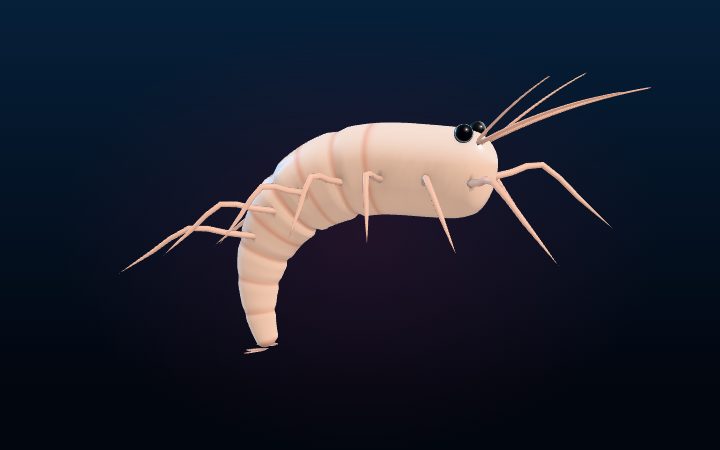
A pale pink-to-orange shrimp-like body about 5 cm long, flattened from the side and curved in an arc, a triangular lobe sticking out at the side of the head, and two pairs of long antennae
More about this creature
Where and how deep it lives
Known only from baited traps set in the Mariana Trench in 2014, with specimens from about 6,010–6,949 m in the upper hadal zone. The holotype (a female) and a juvenile came from about 6,865 m, and a male from about 6,010 m.
Food and hunting
It is a bottom-living scavenger of sunken carcasses. As with its sister species, individuals of several age classes entered the baited traps together. The same traps also caught several other scavenging amphipods, including the supergiant amphipod Alicella gigantea and the hadal amphipods Hirondellea gigas and H. dubia, placing it within the community of amphipods that share carcasses in the trench.
Body and adaptations
Because species in the genus form a cryptic complex that looks very alike, the researchers combined anatomy and genetics to confirm it as new. Distinguishing features include a strongly projecting, slightly triangular lobe on the side of the head, dorsal keels that grow larger toward the rear of the abdomen, and a squared-off rear lower corner on the third side plate of the abdomen, without a small tooth. Sequences of two mitochondrial genes (16S and COI) also placed it in a clearly separate group.
Humans and conservation
Researchers at Newcastle University in the UK (Weston and colleagues) published the description in the taxonomic journal Zootaxa in March 2020; it is the ninth species of Eurythenes. The name plasticus is Latin for 'plastic'. Expedition leader Alan Jamieson said the name was chosen to stress the need for immediate action against the flood of plastic waste entering the sea.
The research was supported by WWF, which used the discovery in its campaign for a legally binding global treaty on plastic pollution. The authors concluded that even species from remote habitats are not exempt from human-made pollution.
Sources & further reading
- Eurythenes plasticus — Wikipedia en.wikipedia.org
- Eurythenes plasticus (2020) — Novataxa novataxa.blogspot.com
- Newcastle University press release (5 March 2020): Eurythenes plasticus www.ncl.ac.uk