Elpidia sea cucumber
Scientific name: Elpidia sp.
The Elpidia sea cucumber is a sea creature that lives near the seafloor at depths of about 7,000–8,100 m, growing to about 5 cm. In Abyss Dive you meet it at 7,500 m, in the Hadal Zone (Hadalpelagic).
- Depth range
- about 7,000–8,100 m
- Max size
- about 5 cm
- Zone in this guide
- Hadal Zone 6,000–10,935 m
- Bioluminescence
- No
- Habitat
- Near the seafloor
- Depth in the 3D dive
- 7,500 m
What is it?
A small sea cucumber a few cm long that moves across the trench floor in groups. Swarms were filmed at about 7,500 m in a trench near Japan, and another species of the same genus was observed at about 8,000 m in the Peru-Chile Trench.
Did you know?
Sea cucumbers are the most common group of large animals on the hadal seafloor, acting as the 'cleaners' of the trench-floor ecosystem.
What it looks like
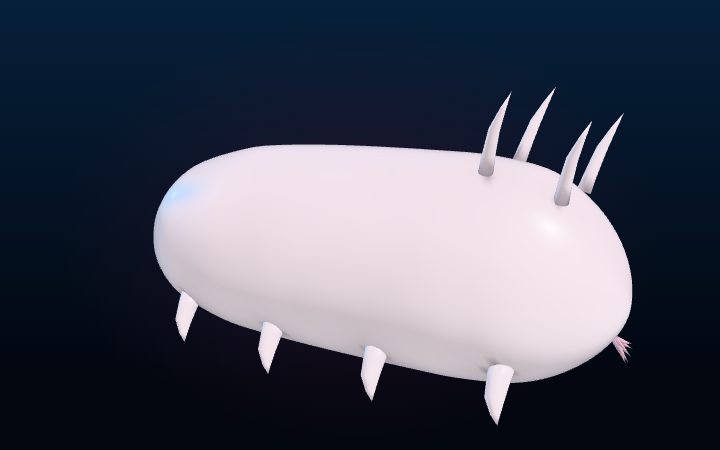
A translucent white-to-pale-pink oval body a few cm long, a few pairs of short, leg-like tube feet on the underside, and a few short projections on the back (a miniature version of the sea pig)
More about this creature
Where and how deep it lives
Twenty-three species are listed in the genus Elpidia, and endemism is high, with different species occupying different deep basins or regions. Some live in polar waters: E. glacialis occurs in the deep Arctic Ocean, Barents and Kara seas and North Atlantic, and in one Greenland Sea canyon at about 3,200 m it reached up to 60 individuals per square metre. Another species, E. minutissima, has been studied at Station M, a long-term abyssal monitoring site in the northeast Pacific.
Its family, Elpidiidae, includes some of the deepest-living sea cucumbers, with several species recorded down to about 9,500 m. A 2025 crewed-submersible survey of trenches around Japan found many sea cucumbers at about 7.5 km in the nutrient-rich Japan Trench, whereas at the same depth in the food-poor Ryukyu Trench they were nearly absent and brittle stars took their place.
Food and hunting
It is a deposit feeder that eats organic matter in the bottom sediment, and its abundance is thought to reflect how much food has accumulated there. As the comparison between the Japan and Ryukyu trenches shows, the amount of food sinking from the surface strongly controls how many sea cucumbers a trench floor can support.
Body and adaptations
Sea cucumbers of the family Elpidiidae have translucent bodies and walk on long, stout tube feet used like legs. Thick, short tentacles ring the mouth, and the back often carries pairs of long upward-pointing tube feet. Elpidia is distinguished by rod-shaped skeletal spicules in the skin, each with two pairs of slanted arms and two upright projections. The family is so adapted to cold that its members fall apart when placed in warm water.
Humans and conservation
The genus was named in 1882 by Théel. Hadal sea cucumbers are hard to observe in deep trenches and were long studied mainly from trawled specimens, but communities are now surveyed with submersible video. The six-dive submersible study of three trenches around Japan recorded nearly 30,000 organisms at about 6,939–9,775 m and concluded that trench biodiversity depends on depth, food supply, seismic activity and seafloor structure.
Sources & further reading
- Deep-sea creatures in Japan's ocean trenches — IFLScience www.iflscience.com
- Rare deep-sea dives reveal what shapes biodiversity in Japan's trenches (Oct 2025) — University of Western Australia www.uwa.edu.au
- Elpidia — Wikipedia en.wikipedia.org
- Elpidia glacialis — Wikipedia en.wikipedia.org