Benthesicymid prawn
Scientific name: Benthesicymus crenatus
The Benthesicymid prawn is a sea creature that lives in open water at depths of about 3,100–9,726 m, growing to about 20 cm. In Abyss Dive you meet it at 7,700 m, in the Hadal Zone (Hadalpelagic).
- Depth range
- about 3,100–9,726 m
- Max size
- about 20 cm
- Zone in this guide
- Hadal Zone 6,000–10,935 m
- Bioluminescence
- No
- Habitat
- Open water (swimming)
- Depth in the 3D dive
- 7,700 m
What is it?
A large red prawn living in the deep Pacific, growing to about 20 cm. In the Kermadec Trench it was filmed hunting amphipods that had gathered at bait.
Did you know?
Filmed at about 7,703 m in a Japanese trench in 2008, it set the record as the deepest decapod (the shrimp-and-crab group) observed in the wild.
What it looks like
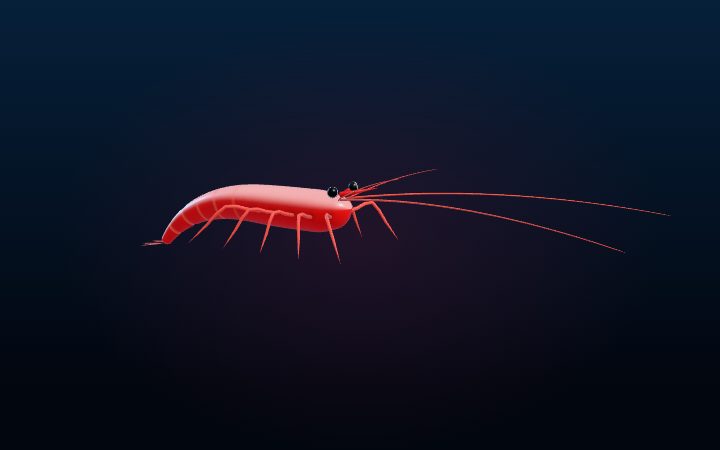
A bright red shrimp-like body about 20 cm long, a short rostrum pointing forward, red antennae longer than the body, thin legs, and a fan-shaped tail
More about this creature
Where and how deep it lives
SeaLifeBase records this species in the Pacific between about 60°N and 35°S and describes it as living in open water at about 3,100–9,726 m. Before 2009 no decapod had been recorded below about 5,700 m, and shrimps and crabs were thought to be absent from the hadal zone.
Researchers from the University of Aberdeen and the University of Tokyo lowered baited video landers into the Kermadec, Tonga and Japan trenches and the Mariana region, and recorded this prawn at most sites. The sighting at about 7,703 m in the Japan Trench extended the known depth limit of decapods by roughly 2,000 m.
Food and hunting
It is drawn to bait, but rather than eating the bait itself it was filmed preying on the smaller scavenging amphipods that crowd around it. The researchers reported this as the first predation ever observed in the hadal zone. Because these observations were made around artificial bait, how often it hunts under natural conditions is unknown.
Life cycle and behaviour
It is classed as having separate sexes, but SeaLifeBase's reproductive information is inferred from the general traits of its prawn group (suborder Dendrobranchiata). Species-specific life-history data such as size at maturity, spawning season or lifespan have not been recorded.
Humans and conservation
It was described in 1881 by Spence Bate. The October 2008 sighting was announced in November 2008 by a team led by Alan Jamieson and Toyonobu Fujii and published formally in Deep-Sea Research the following year. The same study recorded caridean prawns (Acanthephyra) at about 6,007 m and 6,890 m in the Kermadec Trench, confirming that decapods do live in the hadal zone. It has not been evaluated by the IUCN.
Sources & further reading
- Deepest decapod — Guinness World Records www.guinnessworldrecords.com
- Benthesicymus crenatus — SeaLifeBase www.sealifebase.se
- First findings of decapod crustacea in the hadal zone (Jamieson et al. 2009) — NERC Open Research Archive nora.nerc.ac.uk