Supergiant amphipod
Scientific name: Alicella gigantea
The Supergiant amphipod is a sea creature that lives in open water at depths of about 3,890–8,931 m, growing to about 34 cm. In Abyss Dive you meet it at 6,500 m, in the Hadal Zone (Hadalpelagic).
- Depth range
- about 3,890–8,931 m
- Max size
- about 34 cm
- Zone in this guide
- Hadal Zone 6,000–10,935 m
- Bioluminescence
- No
- Habitat
- Open water (swimming)
- Depth in the 3D dive
- 6,500 m
What is it?
Most amphipods are a few millimeters to a few centimeters long, but this 'supergiant' reaches about 34 cm. It scavenges sunken carcasses in deep trenches and on the deep seafloor.
Did you know?
It looks like a shrimp, but it belongs to the same amphipod group as the sand hoppers that jump around on beaches. A 2025 study confirmed it lives at depths of more than about 8,900 m.
What it looks like
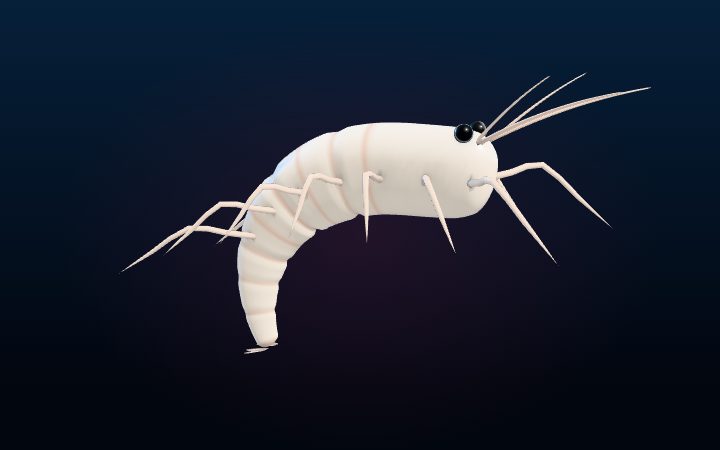
A large, round-curved, milky-white-to-pale-pink shrimp-like body about 30 cm long, smooth back-plate segments, short antennae, and several pairs of thin legs
More about this creature
Where and how deep it lives
It used to be known mainly from about 4,850–7,000 m on the abyssal floor and in trenches such as the Kermadec Trench. In 2025 a University of Western Australia team compiled 195 records from 75 locations in the Pacific, Atlantic and Indian oceans and set the depth range at about 3,890–8,931 m. A habitat-suitability model based on that depth band estimated that the species could live in about 59% of the world's oceans.
It occasionally turns up shallower: a juvenile came from a fish trap at about 1,720 m, and one specimen was found in the stomach of a black-footed albatross in Hawaii. During a 2022 expedition to trenches around Japan it was seen in all three trenches surveyed (Japan, Ryukyu and Izu-Ogasawara).
Food and hunting
Adults are mainly scavengers of carrion, which is why they so often end up in baited traps. Juveniles are thought to eat bacteria and zooplankton debris, shifting to carrion and algae as they grow. Its gut microbes are dominated by Candidatus Hepatoplasma.
Body and adaptations
The body is mostly white rather than the red-to-orange typical of deep-sea amphipods, which some interpret as a sign that it has few predators. Adults are too big to be eaten by the Kermadec snailfish, although grenadier stomachs have contained individuals of about 40–100 mm.
Proposed reasons for its size include larger cells and a longer lifespan, and a 2021 study found growth-regulating genes over-represented. Its genome, estimated in 2017 at about 34 billion base pairs, is far larger than those of other deep-sea amphipods studied. Males and females look almost the same.
Life cycle and behaviour
Females carry their eggs in a brood pouch and probably produce several broods in a lifetime. The eggs are oval and about 6.95–14.88 mm across. Carbon-14 analysis suggests a lifespan of more than 10 years. In the 2025 study most populations shared the same haplotype for each gene, indicating a single species with strong gene flow between distant populations.
Humans and conservation
The first two specimens were caught in 1897 by the research ship Princess Alice, named after the wife of Prince Albert I of Monaco, in triangular traps set at about 5,285 m on the Madeira Abyssal Plain off the Canary Islands. Édouard Chevreux described the species in 1899 and named the genus after the ship; the specimens are kept at the Oceanographic Museum of Monaco.
The 2025 study's lead author, Paige Maroni, argued that the species is under-sampled rather than rare. Meanwhile a 2020 study detected DDT and chlordane in specimens and a 2022 study found high levels of cadmium and chromium, raising the concern that its carrion diet may expose it to chemical pollution.