Stalked sea lily
Scientific name: Bathycrinus sp.
The Stalked sea lily is a sea creature that lives near the seafloor at depths of about 1,000–9,735 m, growing to about 50 cm. In Abyss Dive you meet it at 9,100 m, in the Hadal Zone (Hadalpelagic).
- Depth range
- about 1,000–9,735 m
- Max size
- about 50 cm
- Zone in this guide
- Hadal Zone 6,000–10,935 m
- Bioluminescence
- No
- Habitat
- Near the seafloor
- Depth in the 3D dive
- 9,100 m
What is it?
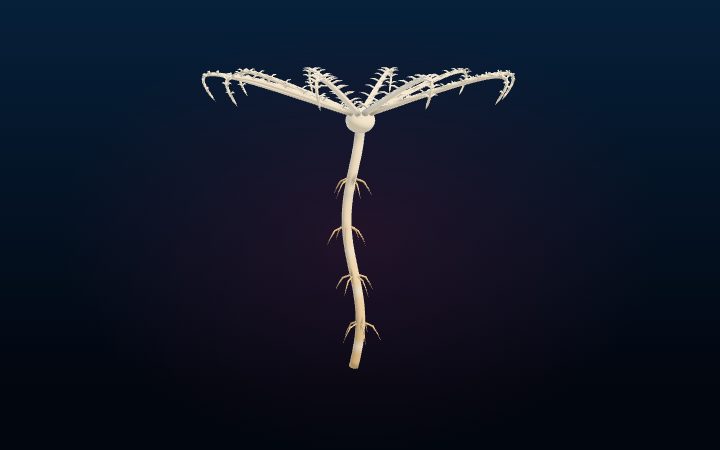
It looks like a plant, but it's an echinoderm, like starfish and sea urchins. It anchors to the bottom with a long stalk and spreads its feathery arms to filter drifting food. Dense 'meadows' of sea lilies have been seen below 9,000 m in trenches near Japan.
Did you know?
A species of the genus Bathycrinus was collected at about 9,700 m in the Izu-Ogasawara Trench, making it the deepest-living sea lily. Crinoids have lived in the oceans for more than 400 million years, which makes them 'living fossils'.
What it looks like
A thin, long, jointed stalk rising from the bottom, with five to ten feathery arms spreading upward from a small cup at the top like a flower; pale beige
More about this creature
Where and how deep it lives
Hadal sea lilies are known mostly from trawled specimens. Bathycrinus australis has been taken at about 8,210–8,300 m in the Kermadec Trench, and B. volubilis at about 8,175–9,584 m in the Kuril-Kamchatka Trench. Crinoids as a group range from shallow water to more than 9,000 m.
In 1999 JAMSTEC's remotely operated vehicle Kaiko filmed dense aggregations at about 8,994–9,102 m on the western slope of the northern Izu-Ogasawara Trench, about 110 km southeast of Tokyo. The animals grew only on consolidated sedimentary rock, cobbles and boulders, never on mud, and were the most abundant large invertebrates in the area. During a 2022 expedition, more than 1,500 stalked crinoids were recorded on rock terraces at about 9,137 m at the foot of the Boso Triple Junction in the same trench.
Food and hunting
Crinoids are passive suspension feeders that sieve particles carried by the current. They spread their arms into a fan facing the flow, extended tube feet form a mesh, and sticky mucus traps the particles. The food is then moved to the mouth along grooves in the arms by beating cilia.
In the 1999 footage the sea lilies held their arms in fans aligned with the current and folded them inward when disturbed. Organic matter usually declines with depth, but the researchers found no sign of hydrothermal vents or seeps and suggested that the trench's shape funnels sinking organic material, supplying enough food.
Body and adaptations
One animal measured in the 1999 footage had a stalk of about 13 cm, arms of about 10 cm, and 10 arms bearing long pinnules. A sea lily's stalk is a column of porous skeletal discs, anchored by a flat holdfast or by jointed root-like cirri. The tube feet on the arms grow in groups of three and have no suckers.
Fourteen species of Bathycrinus are currently recognised. B. kirilli, described in 2019, differs from its close relative B. volubilis by features such as a high lengthwise keel on the arm segments.
Life cycle and behaviour
Crinoids have separate sexes, and gametes are released into the water when gonads, mostly in the pinnules, rupture. The larva swims for only a few days before settling and transforming into a stalked juvenile. Lost arms grow back, and the visceral mass can regenerate within a few weeks. These are traits of crinoids in general; reproduction in hadal species has hardly been observed.
Humans and conservation
The genus Bathycrinus was described in 1872 by Charles Wyville Thomson. B. kirilli, regarded as the deepest-living crinoid, was described in 2019 by Mironov from material taken at about 9,715–9,735 m in the Izu-Ogasawara (Izu-Bonin) Trench; the ship that trawled crinoids from about 9,700 m there was the Soviet research vessel Vityaz. In the same paper Mironov discussed why the deepest Bathycrinus species occur in greater abundance than species from shallower habitats.
Sources & further reading
- What are the DEEPEST known echinoderms? — The Echinoblog echinoblog.blogspot.com
- Deep-sea creatures in Japan's ocean trenches — IFLScience www.iflscience.com
- Discovery of dense aggregations of stalked crinoids in Izu-Ogasawara Trench, Japan (Oji et al. 2009) — Zoological Science / BioOne bioone.org
- Sea lilies of the genus Bathycrinus from the North-West Pacific hadal trenches (Mironov 2019) — Zootaxa www.mapress.com
- Crinoid — Wikipedia en.wikipedia.org