Mariana snailfish
Scientific name: Pseudoliparis swirei
The Mariana snailfish is a sea creature that lives in open water at depths of about 6,200–8,180 m, growing to about 23 cm. In Abyss Dive you meet it at 7,600 m, in the Hadal Zone (Hadalpelagic).
- Depth range
- about 6,200–8,180 m
- Max size
- about 23 cm
- Zone in this guide
- Hadal Zone 6,000–10,935 m
- Bioluminescence
- No
- Habitat
- Open water (swimming)
- Depth in the 3D dive
- 7,600 m
What is it?
A small fish that is abundant at about 7,000–8,000 m in the Mariana Trench. With a scaleless, translucent pink body, it's the top predator of the trench ecosystem, preying on swarms of amphipods drawn to bait.
Did you know?
Its bones don't fully harden, which helps it withstand the immense pressure. Its eggs are about 9.4 mm across, among the largest of any bony fish.
What it looks like
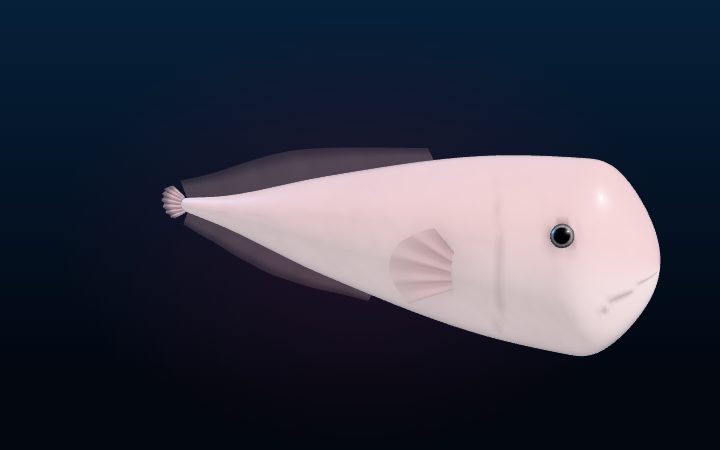
A translucent pink, tadpole-shaped body about 20 cm long (scaleless, see-through), a round head, wing-like broad pectoral fins, and dorsal and anal fins joined to the tail
More about this creature
Where and how deep it lives
It is known only from the Mariana Trench, at recorded depths of about 6,198–8,178 m. Video showed it most abundant at about 7,000–8,000 m, and none were seen below 8,200 m, which FishBase treats as the apparent physiological limit for bony fishes. Smaller individuals tend to be caught deeper, and the larvae are thought to spend time in open water shallower than 1,000 m.
Body and adaptations
It has a pale, tadpole-like body with transparent, unpigmented skin. Some organs and the eggs are enlarged, and the muscles are thin. It has a well-developed sucking disc on the belly and lacks a pseudobranch and ribs. It appears to have little or no ability to see.
A 2019 genome study by a Chinese team in Nature Ecology & Evolution found that some genes for light sensitivity have been lost, while other vision-related genes remain, so it may still see to some degree. Changes in gene families for making fatty acids were interpreted as helping cell membranes stay flexible at depth, and other changes as helping proteins avoid misfolding under pressure. The researchers also noted that a largely cartilage skeleton copes with high pressure better than hard bone.
Life cycle and behaviour
Ripe females carried up to 23 large eggs over 5 mm across together with up to 851 small eggs less than half that size. Intermediate sizes were rare, and even the largest eggs showed no sign of developing embryos. Males have a noticeable forward-pointing genital papilla. FishBase estimates high resilience, with a population able to double in under 15 months.
Humans and conservation
It was first caught in 2014 on an expedition of the research vessel Falkor, using traps baited with mackerel. After the first fish came up on 15 November, another 35 were caught over the next ten days, and the holotype was taken on 21 November at about 7,949 m. Gerringer and colleagues described it as a new species in Zootaxa in 2017. The name honours Herbert Swire, a navigating officer on HMS Challenger, whose 1870s expedition found the Challenger Deep.
A fish caught at about 7,966 m was possibly the deepest fish ever collected from the seafloor, until a related snailfish, P. belyaevi, was caught at about 8,022 m in the Japan Trench in 2022. Its skull structure inspired the design of a self-powered deep-diving robot. It has not been evaluated by the IUCN.
Sources & further reading
- Pseudoliparis swirei — FishBase www.fishbase.se
- Pseudoliparis swirei — Wikipedia en.wikipedia.org
- Sequencing of snailfish from the Mariana Trench reveals adaptations (April 2019) — Phys.org phys.org