Xenophyophore
Scientific name: Xenophyophorea
The Xenophyophore is a sea creature that lives near the seafloor at depths of about 500–10,600 m, growing to about 20 cm. In Abyss Dive you meet it at 10,600 m, in the Hadal Zone (Hadalpelagic).
- Depth range
- about 500–10,600 m
- Max size
- about 20 cm
- Zone in this guide
- Hadal Zone 6,000–10,935 m
- Bioluminescence
- No
- Habitat
- Near the seafloor
- Depth in the 3D dive
- 10,600 m
What is it?
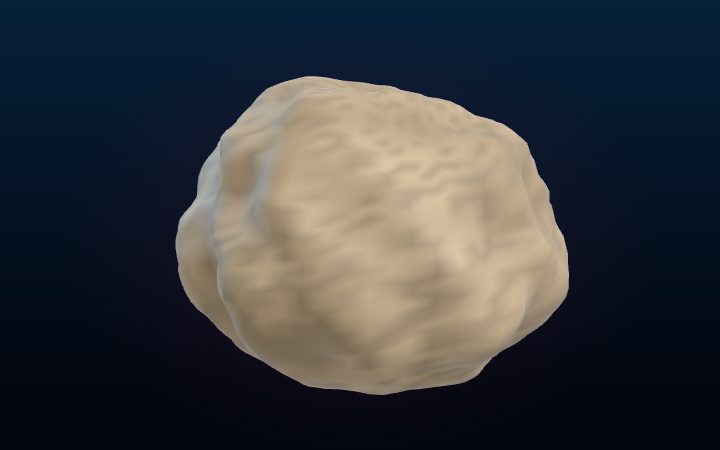
It looks like a lump of sponge sitting on the seafloor mud, but it's a protist made of a single cell with many nuclei. It builds its shell by gluing together grains of sediment and fragments of other organisms' shells.
Did you know?
The largest species grow to about 20 cm across, among the largest single-celled organisms on Earth. They've been found at depths of about 10,600 m.
What it looks like
A crumbly, earth-colored lump 10–20 cm across, with a surface of thin plates folded in layers or tangled like a net, sitting on the bottom mud
More about this creature
Where and how deep it lives
They occur on the floor of all four major ocean basins, at recorded depths of about 500–10,600 m. They are common where much organic carbon sinks from above but are absent from oxygen-poor water. In places they carpet the bottom at up to 2,000 individuals per 100 square metres.
In July 2011 a Scripps Institution of Oceanography team used landers to document them at about 10,641 m in the Sirena Deep of the Mariana Trench; the previous depth record was about 7,500 m in the New Hebrides Trench. In the Clarion–Clipperton Zone of the Pacific they are the dominant group of large seafloor organisms.
Food and hunting
Proposed feeding modes have included suspension feeding, farming bacteria, eating sediment and trapping particles. Studies confirm that they actively take in food through pseudopodia and trap particles, and their waste pellets contain many bacteria. A 2021 isotope experiment found rapid uptake of diatoms and glucose and no evidence of bacterial farming, suggesting they may help collect plant debris settling on the seafloor.
Body and adaptations
The cell consists of a branching mass of cytoplasm (the granellare) within a system of tubes, and barite crystals are common in the cytoplasm. Waste pellets are kept inside the shell as strings called stercomare. Individual cells often exceed 10 cm.
Because they trap surrounding particles, they concentrate elements such as lead, uranium and mercury, and many species carry unusually high levels of natural radionuclides. This suggests a high tolerance for heavy metals.
Life cycle and behaviour
Growth happens in bursts. One species, Reticulammina labyrinthica, grew three- to tenfold over eight months in phases of two to three days separated by rests of about two months, suggesting they may not be as long-lived as once thought. Reproduction is poorly understood: an alternation of generations is assumed, and gametes about 20 μm across with two flagella have been reported.
On the seafloor they create habitat for other animals. Areas they dominate hold three to four times as many crustaceans, echinoderms and molluscs; isopods, nematodes and copepods live on or inside the shells, and snailfish have been found laying eggs in their shelter. Sea stars, sea cucumbers and the deep-sea monoplacophoran Neopilina galatheae feed on them.
Humans and conservation
Henry Bowman Brady described them in 1883 as primitive foraminifera; they were later treated as a separate group, but genetic studies now place them as a specialised group of single-chambered foraminifera. The name means 'bearer of foreign bodies'. In the Clarion–Clipperton Zone, an area licensed for polymetallic nodule exploration, a single 2018 paper described five new species and two new genera, most of them living attached to the nodules.
Sources & further reading
- Xenophyophorea — Wikipedia en.wikipedia.org
- Scientists ID giant amoebas in the extreme deep (2011) — Scripps Institution of Oceanography scripps.ucsd.edu
- Five new species and two new genera of xenophyophores from part of the abyssal equatorial Pacific licensed for polymetallic nodule exploration (Gooday et al. 2018) — NERC Open Research Archive nora.nerc.ac.uk