Hadal amphipod
Scientific name: Hirondellea gigas
The Hadal amphipod is a sea creature that lives in open water at depths of about 6,000–10,935 m, growing to about 5 cm. In Abyss Dive you meet it at 10,900 m, in the Hadal Zone (Hadalpelagic).
- Depth range
- about 6,000–10,935 m
- Max size
- about 5 cm
- Zone in this guide
- Hadal Zone 6,000–10,935 m
- Bioluminescence
- No
- Habitat
- Open water (swimming)
- Depth in the 3D dive
- 10,900 m
What is it?
An amphipod a few cm long that lives in swarms near the bottom of the Challenger Deep. It lives on organic matter that sinks to the bottom.
Did you know?
A 2012 study by the Japan Agency for Marine-Earth Science and Technology (JAMSTEC) showed it has enzymes that break down cellulose from sunken plant debris, such as bits of wood, into glucose.
What it looks like
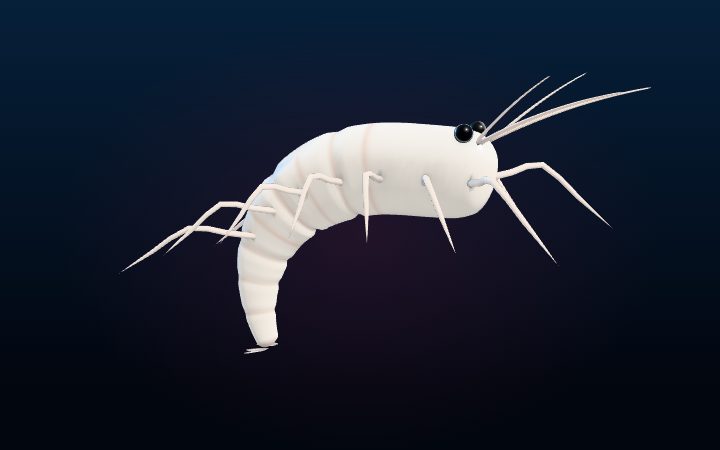
A milky-white shrimp-like body a few cm long, flattened from the side and curved in an arc, short antennae, several pairs of thin legs, moving in swarms
More about this creature
Where and how deep it lives
Besides the Challenger Deep in the Mariana Trench, it is known from the deepest parts of the Philippine, Izu-Ogasawara and Japan trenches, living mostly below 8,000 m. Specimens for research have been collected at about 10,897 m in the Challenger Deep and about 9,450 m in the Izu-Ogasawara Trench.
Food and hunting
In 2012 JAMSTEC analysed the digestive enzymes of 185 of these amphipods caught at about 10,900 m in the Challenger Deep with baited traps on ASHURA, a free-fall sampler rated to 11,000 m. Besides cellulase, they found amylase, which breaks down starch, and mannanase and xylanase, which break down plant hemicellulose, and the bodies contained the products glucose, maltose and cellobiose. The researchers concluded that the amphipod lives partly by digesting plant material that has sunk to the trench floor.
Trapped animals had bait, sediment or nothing at all in their guts. It is described as a scavenger that eats whatever it can in a nutrient-poor environment.
Body and adaptations
It is a little over 3 cm from head to tail. Calcium carbonate, a key component of crustacean shells, dissolves in seawater below about 4,000–5,000 m (the carbonate compensation depth), and this amphipod's shell contains very little of it.
In 2019 Kobayashi and colleagues showed that aluminium coats the surface of the shell, especially on the tail segment and along the legs. Their explanation is that gluconolactone, made from glucose obtained from food, dissolves aluminium out of the sediment, which then forms an aluminium hydroxide gel in alkaline seawater that covers the body. In a test at 100 MPa, shells without the gel released more calcium, which was interpreted as the gel protecting the calcium carbonate.
Humans and conservation
JAMSTEC researchers noted that a new cellulase purified from the amphipod produced glucose from sawdust and paper at room temperature, and named it a promising candidate for bioethanol production.
Human pollution reaches even here. In a 2019 study of amphipods from six Pacific trenches, every animal from the Mariana Trench, where this species was sampled, had swallowed microparticles, averaging about 3.3 per individual, the highest of any trench surveyed. Persistent pollutants such as PCBs and PBDEs have also been detected in amphipods from the Mariana and Kermadec trenches.
Sources & further reading
- JAMSTEC press release (2012-08-16): cellulase of Hirondellea gigas www.jamstec.go.jp
- An aluminum shield enables the amphipod Hirondellea gigas to inhabit deep-sea environments (Kobayashi et al. 2019) — PLOS ONE / PMC pmc.ncbi.nlm.nih.gov
- Microplastics and synthetic particles ingested by deep-sea amphipods in six of the deepest marine ecosystems on Earth (Jamieson et al. 2019) — PMC pmc.ncbi.nlm.nih.gov
- Marine, extreme, but not pristine: anthropogenic pollution in the deepest ecosystem on Earth — Springer Nature Research Communities communities.springernature.com