Abyssal spiderfish
Scientific name: Bathypterois longipes
The Abyssal spiderfish is a sea creature that lives near the seafloor at depths of about 2,615–5,610 m, growing to about 25 cm. In Abyss Dive you meet it at 5,000 m, in the Abyssal Zone (Abyssopelagic).
- Depth range
- about 2,615–5,610 m
- Max size
- about 25 cm
- Zone in this guide
- Abyssal Zone 4,000–6,000 m
- Bioluminescence
- No
- Habitat
- Near the seafloor
- Depth in the 3D dive
- 5,000 m
What is it?
A relative of the tripod fish that lives on deeper abyssal plains. In cold water of 0–5°C it stands propped on its fin rays like a tripod.
Did you know?
Its pectoral-fin rays, spread wide forward, serve as sensory organs that detect small crustaceans drifting by.
What it looks like
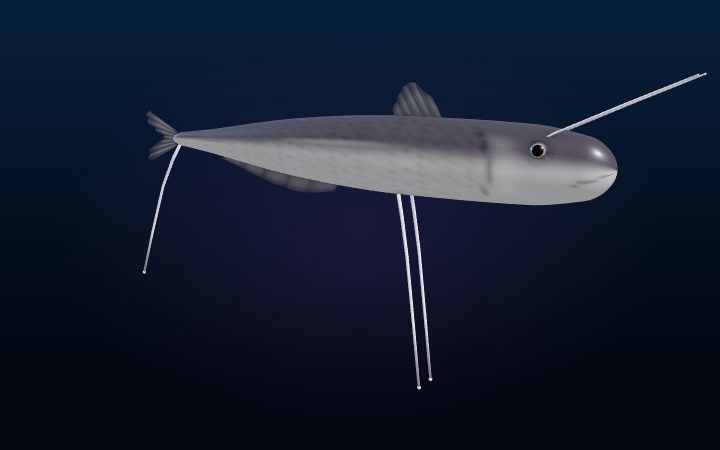
A slender, dark gray body about 25 cm long, three long fin rays planted on the bottom (two pelvic, one below the tail), and thin pectoral-fin rays fanned out forward
More about this creature
Where and how deep it lives
In the Atlantic it is recorded off northwest Africa (south of Cape Verde and off Cape Blanc), off southwest Africa, on both sides of the North Atlantic, and off Uruguay in the South Atlantic; it also turns up at scattered localities in the Pacific. It lives on the bottom at about 2,615–5,610 m, among the deeper-living fishes known. FishBase gives a water temperature range of about 0.4–4.5 °C.
Food and hunting
It feeds on planktonic crustaceans, with an estimated trophic level of about 3.1. It lives alone, holding position above the bottom and waiting for food carried in on the current.
Body and adaptations
Elongated fin rays act as a tripod that lifts the body off the bottom into the water. In its relative the tripodfish (Bathypterois grallator) these fins can be three times the body length, up to about a metre. Fishes of this family (Ipnopidae) have either tiny eyes or large eyes without a lens, and cannot form an image. The largest recorded specimen measured about 24.9 cm standard length.
Life cycle and behaviour
FishBase classes it as a synchronous hermaphrodite, carrying male and female reproductive organs at the same time. The record notes this alongside its solitary habits, but gives no details on spawning or eggs. Its resilience is rated very low, with a population doubling time estimated at more than 14 years.
Humans and conservation
It was described in 1878 by Albert Günther. It is of no interest to fisheries and harmless to people. The IUCN Red List classes it as Least Concern, with FishBase listing an assessment date in 2013.
Sources & further reading
- Bathypterois longipes — FishBase www.fishbase.se
- Bathypterois longipes — Wikipedia en.wikipedia.org
- Ipnopidae — Wikipedia en.wikipedia.org