Pacific abyssal grenadier
Scientific name: Coryphaenoides yaquinae
The Pacific abyssal grenadier is a sea creature that lives in open water at depths of about 3,400–5,800 m, growing to about 63 cm. In Abyss Dive you meet it at 5,500 m, in the Abyssal Zone (Abyssopelagic).
- Depth range
- about 3,400–5,800 m
- Max size
- about 63 cm
- Zone in this guide
- Abyssal Zone 4,000–6,000 m
- Bioluminescence
- No
- Habitat
- Open water (swimming)
- Depth in the 3D dive
- 5,500 m
What is it?
A rattail that lives near the bottom of Pacific abyssal plains, mostly at 3,400–5,800 m.
Did you know?
It grows very slowly and breeds late, and is assessed as needing more than 14 years to recover if its numbers fall.
What it looks like
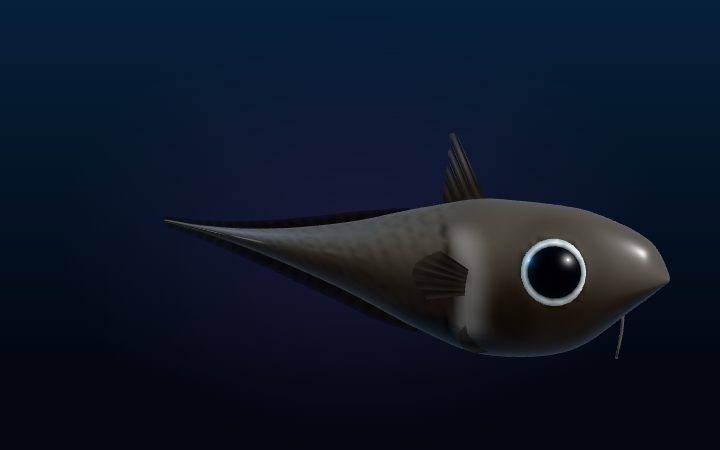
A big head and big eyes, a dark gray-brown body tapering to a thread at the tail tip, and a tall first dorsal fin
More about this creature
Where and how deep it lives
FishBase, citing records from the Pacific including the Kuril Islands and Japan, describes it as living near the bottom at about 3,400–5,800 m. A 2024 genome study, however, gives about 3,655–7,259 m, and a 2022 study of hadal fish gut microbes gives about 3,000–7,000 m, suggesting it spans the abyssal plains and the upper hadal zone. The 2022 study calls it one of the most widespread fishes in abyssal ecosystems.
Food and hunting
It feeds mainly on carrion, and also takes squid, crustaceans and other fish, with an estimated trophic level of about 4.0. In the 2022 study, fish caught at about 4,441–6,081 m had gut microbial communities far more even than those of hadal snailfishes, and lineages related to pressure-loving bacteria, Shewanella and Moritella, were found in every individual.
Body and adaptations
It reaches about 63 cm total length. In 2024 Li and colleagues assembled a chromosome-level genome and compared it with shallow, abyssal and hadal fishes, finding genetic changes linked to light perception, daily rhythms, pressure tolerance and tolerance of hunger. Deep-sea fishes living at different depths shared parallel amino-acid changes in the visual pigment rhodopsin 1 and in genes tied to energy use (PDX1, MC4R), and fishes reaching hadal depths also showed parallel changes in pressure-related protein genes (HSP90B1, VCP).
Humans and conservation
It was described in 1974 by Iwamoto and Stein, and the species name honours the research vessel Yaquina, from which the type specimens were collected. New records from the western North Pacific were published in 1992. It is of no interest to fisheries and has not been evaluated by the IUCN. FishBase rates its vulnerability to fishing as high to very high.
Sources & further reading
- Coryphaenoides yaquinae — FishBase www.fishbase.se
- Microbiomes of Hadal Fishes across Trench Habitats Contain Similar Taxa and Known Piezophiles (Blanton et al. 2022) — mSphere / PMC pmc.ncbi.nlm.nih.gov
- Li et al. 2024, chromosome-level genome of Coryphaenoides yaquinae — Molecular Ecology Resources (ZFIN record) zfin.org