Abyssal grenadier (Rattail)
Scientific name: Coryphaenoides armatus
The Abyssal grenadier (Rattail) is a sea creature that lives in open water at depths of about 280–5,180 m, growing to about 1 m. In Abyss Dive you meet it at 4,300 m, in the Abyssal Zone (Abyssopelagic).
- Depth range
- about 280–5,180 m
- Max size
- about 1 m
- Zone in this guide
- Abyssal Zone 4,000–6,000 m
- Bioluminescence
- No
- Habitat
- Open water (swimming)
- Depth in the 3D dive
- 4,300 m
What is it?
A fish with a big head and a body that tapers to a rat-like tail. It's one of the most commonly seen fish on abyssal plains.
Did you know?
It's the regular first guest when a baited camera is lowered to the seafloor, finding sunken food quickly by smell.
What it looks like
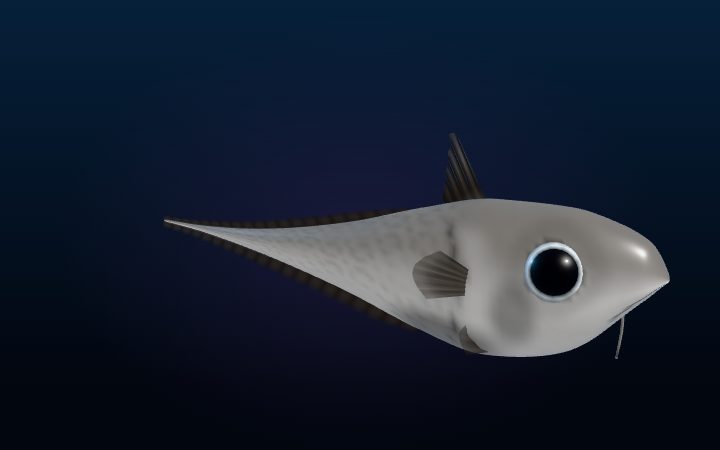
A gray-brown body tapering from a big head with big eyes to a thread-thin tail tip (no tail fin), a tall first dorsal fin, and a short barbel under the chin
More about this creature
Where and how deep it lives
It occurs in all oceans except the polar seas, though records from the Indian Ocean and the South Pacific off South America are scarce. It lives mainly on the deep continental slope and upper continental rise, centred on about 2,000–4,700 m, with sightings from about 282 m to a little over 5,000 m. In the Pacific it tends to be restricted to nutrient-rich areas at about 2,000–4,300 m.
A study in the Porcupine Seabight, northeast Atlantic (published 1994), found it was the dominant scavenger at baits on the continental rise and made up 41.5% of trawl catches there. At about 2,897 m its estimated density was about 877 fish per km², more than five times that on the abyssal plain.
Food and hunting
Its diet changes with age. Juveniles eat bottom invertebrates such as crustaceans and sea cucumbers, while adults mainly take midwater and deep-water fishes, cephalopods and sea urchins. Where phytodetritus falls often, it eats that too.
Young fish rely more on sight than smell, whereas adults are described as smell specialists. Researchers found a relationship between how quickly the first fish reaches a bait and how many fish live in the area, so arrival times at baited cameras are used to estimate population density.
Body and adaptations
It has a very large head and eyes, a small mouth, a brown body and a bluish belly. Adults are usually about 20–40 cm long, though FishBase lists fish up to about 102 cm. Its metabolic rate is low and its aerobic activity slow, which is interpreted as a way to save energy where food is scarce.
Life cycle and behaviour
Rather than waiting for food, it forages actively, behaving in line with optimal foraging theory. It swims faster in months when more marine snow reaches the bottom, and in the eastern North Pacific its numbers rise with the supply of carrion.
Ripe females are rarely caught and spent fish never have been, suggesting it may breed only once before dying. In the Rockall Trough of the northeast Atlantic a male-to-female ratio of about 2.6 to 1 has been reported.
Humans and conservation
It has no fisheries value and is rated Least Concern on the IUCN Red List, though FishBase considers its resilience very low, with a population doubling time of more than 14 years. It features in many deep-sea studies using baited cameras, acoustic tags and autonomous landers, and the genetic structure of populations around the Mid-Atlantic Ridge has also been studied.