Sea pig
Scientific name: Scotoplanes globosa
The Sea pig is a sea creature that lives near the seafloor at depths of about 1,200–5,000 m, growing to about 15 cm. In Abyss Dive you meet it at 4,700 m, in the Abyssal Zone (Abyssopelagic).
- Depth range
- about 1,200–5,000 m
- Max size
- about 15 cm
- Zone in this guide
- Abyssal Zone 4,000–6,000 m
- Bioluminescence
- No
- Habitat
- Near the seafloor
- Depth in the 3D dive
- 4,700 m
What is it?
A plump sea cucumber that walks along the seafloor on tube feet modified into legs. Hundreds gather in herds, feeding on organic matter in the mud (herds of 300–600 have been collected).
Did you know?
It's called a 'sea pig' for the antenna-like projections on its back, and young crabs have been seen sheltering underneath its body.
What it looks like
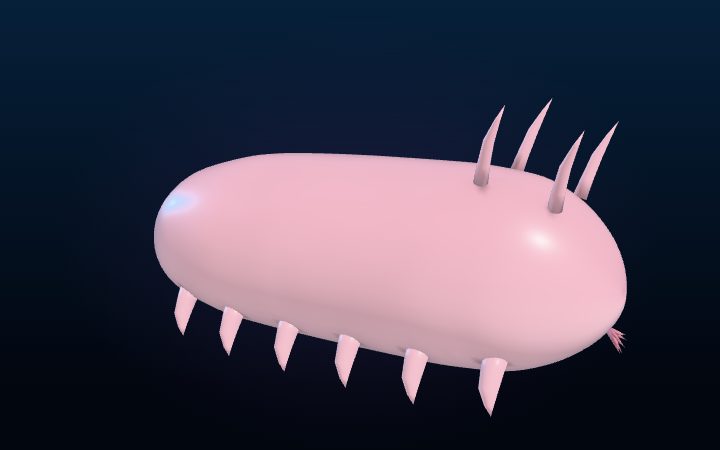
A plump, translucent pink oval body 10–15 cm long, 5–7 pairs of short, leg-like tube feet on the underside, and 2–3 pairs of antenna-like projections rising from the front of the back
More about this creature
Where and how deep it lives
The Monterey Bay Aquarium Research Institute (MBARI) describes sea pigs as living on the seafloor at about 1,000–6,000 m, especially on abyssal plains, with a worldwide range. They occur mainly at about 1,200–5,000 m on abyssal plains of the Atlantic, Pacific and Indian oceans, and related species live in Antarctic waters. Off Monterey Bay they are among the animals most often seen on the deep seafloor.
Food and hunting
Sea pigs are deposit feeders that eat organic debris lying on the sediment. Ten tentacles around the mouth and the tube feet gather organic particles from the mud surface, and the gut is efficient at extracting nutrients from scarce food. They strongly prefer fresh, newly settled organic matter, locate it by smell, and have been seen feeding in large groups around sunken whale carcasses.
Body and adaptations
The body is bilaterally symmetrical and translucent, about 10–15 cm long as an adult and up to about 17 cm. There are six pairs of tube feet, largest at mid-body and smallest near the anus. Most sea cucumbers keep short tube feet tucked under the body, but sea pigs use long ones to hold themselves above the mud.
The tube feet and the dorsal papillae work through a water vascular system driven by hydraulic pressure in muscular canals. The nervous system is a net without ganglia, and respiration is poorly developed, with gas exchange described as taking place through the anus. The body is built for deep-sea pressure and falls apart when brought near the surface.
Life cycle and behaviour
Sea pigs gather in large numbers to feed or mate, and when disturbed they can swim using lobes at the front and rear of the body. Like other sea cucumbers they have a single gonad. Unlike most of their deep-sea relatives, both sexes show active production of sex cells, which may point to a different reproductive strategy. Snails and small tanaid crustaceans live on them as parasites or commensals.
The young crabs that shelter underneath them are juvenile king crabs, Neolithodes diomedeae, which gain protection from predators. MBARI researchers reported the relationship in 2016, but what the sea pig gets out of it is still unknown.
Humans and conservation
The genus Scotoplanes was named by Théel in 1882, based on sea cucumbers dredged during the British Challenger expedition of 1873–1876. MBARI has watched seafloor animals for decades at Station M, a site about 4,000 m deep, and found that communities including sea pigs change sharply and erratically over time for reasons not yet understood. In 2024 a bright pink, undescribed species was found in the Clarion–Clipperton Zone, an area proposed for deep-sea mining.
Sources & further reading
- Scotoplanes — Wikipedia en.wikipedia.org
- Sea pig — MBARI www.mbari.org