Casper octopus
Scientific name: Incirrata (undescribed)
The Casper octopus is a sea creature that lives near the seafloor at depths of about 4,200–4,400 m, growing to about 10 cm. In Abyss Dive you meet it at 4,290 m, in the Abyssal Zone (Abyssopelagic).
- Depth range
- about 4,200–4,400 m
- Max size
- about 10 cm
- Zone in this guide
- Abyssal Zone 4,000–6,000 m
- Bioluminescence
- No
- Habitat
- Near the seafloor
- Depth in the 3D dive
- 4,290 m
What is it?
An octopus first filmed in 2016 by the NOAA ship Okeanos Explorer, on rock at about 4,290 m near Necker Island, Hawaii. No specimen has been collected yet, so it has no formal scientific name.
Did you know?
It has no pigment cells in its skin, so it's a ghostly, translucent white, hence the nickname 'Casper' after the friendly cartoon ghost. At the time, it was the deepest record for a finless octopus.
What it looks like
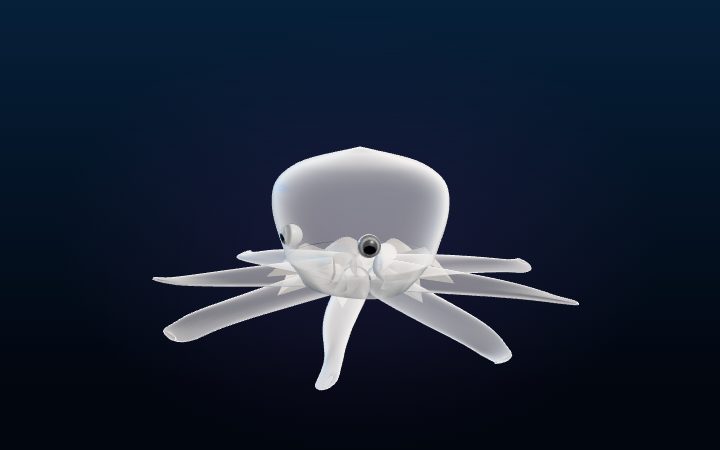
A small, soft, translucent white body (no pigment), no fins, eight short arms with a single row of suckers, two small black eyes, and lying flat on the rock
More about this creature
Where and how deep it lives
It was first filmed on the Necker Ridge northeast of Necker Island in the Hawaiian Archipelago, inside Papahānaumokuākea Marine National Monument. Between 2011 and 2016, Purser and colleagues surveyed the Ka'ena and Necker Ridges off Hawaii and a nodule-rich area of the Peru Basin in the southeast Pacific with ROVs and towed cameras, recording 29 finless octopods belonging to what appear to be two species. Similar animals have been reported off Ecuador and on the Nazca Ridge. Bottom water at these depths, below 4,000 m, stays at about 1.5 °C year-round.
Body and adaptations
It belongs to the finless (incirrate) octopods, unlike finned cirrates such as the dumbo octopus. It has short arms with a single row of suckers each, and video suggests very little muscle and an almost gelatinous body. Because no specimen has been collected, its exact size and internal anatomy remain unknown.
Life cycle and behaviour
In the Peru Basin, below 4,000 m, two individuals were found brooding clutches of eggs laid on the stalks of dead sponges growing on manganese nodules. Each clutch held about 30 large eggs, 2.0–2.7 cm long. With water at about 1.5 °C, the researchers suggested development, and therefore brooding, could take years. It was the first time incirrate octopods had been seen relying on minerals and the life on them in this way.
Humans and conservation
The Deep Discoverer ROV filmed it in February 2016 during NOAA's Hohonu Moana 2016 expedition (EX1603). At the time, all published depth records for finless octopods were shallower than 4,000 m, and the group was known mainly down to about 3,000 m. NOAA said it is almost certainly an undescribed species and may not fit any described genus.
The sponges that hold the eggs need nodules to grow on, and in the Peru Basin's DISCOL experiment area their populations nearly collapsed after nodules were removed. The researchers warned that commercial mining of nodule fields and crusts could likewise wipe out the octopods' breeding sites.
Sources & further reading
- Casper (octopus species) — Wikipedia en.wikipedia.org
- "Casper" Octopus — NOAA Ocean Exploration oceanexplorer.noaa.gov
- Purser et al. 2016, Association of deep-sea incirrate octopods with manganese crusts and nodule fields in the Pacific Ocean (Current Biology) — GEOMAR OceanRep oceanrep.geomar.de