Umbellula sea pen
Scientific name: Umbellula sp.
The Umbellula sea pen is a sea creature that lives near the seafloor at depths of about 250–6,200 m, growing to about 2 m. In Abyss Dive you meet it at 4,550 m, in the Abyssal Zone (Abyssopelagic).
- Depth range
- about 250–6,200 m
- Max size
- about 2 m
- Zone in this guide
- Abyssal Zone 4,000–6,000 m
- Bioluminescence
- No
- Habitat
- Near the seafloor
- Depth in the 3D dive
- 4,550 m
What is it?
A sea pen (a relative of corals) with a long, thin stalk rooted in the muddy bottom and a cluster of large polyps only at the top. It's a signature animal of abyssal plains and lives at depths of over 6,000 m.
Did you know?
Depending on the species, the stalk can exceed 2 m. It spreads the tentacles of the polyps at the top to filter drifting food.
What it looks like
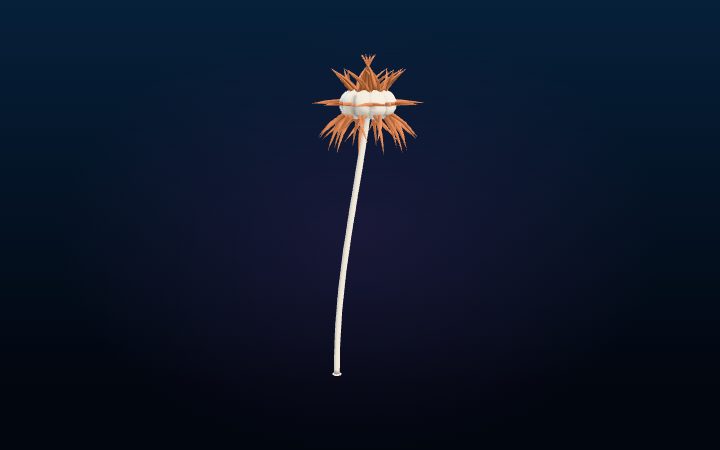
A very thin, long white stalk rising from the bottom (1–2 m tall), a bouquet of several to a dozen large polyps (with orange tentacles) at the top, and a stalk that bends in the current
More about this creature
Where and how deep it lives
Umbellula ranges from bathyal depths to the abyssal plains and is best known from the Arctic Ocean and the northeast and South Atlantic. It is one of the few sea pen genera found deeper than 4,000 m. The widespread U. lindahli has been recorded at about 250–6,100 m in every major ocean and is common around Antarctica; in a Porcupine Seabight survey (650–3,850 m) it was the most frequently seen species. U. encrinus forms dense stands in Baffin Bay in the eastern Canadian Arctic, especially in Lancaster Sound.
Food and hunting
U. lindahli is a passive suspension feeder that spreads its tentacles wide to strain small organisms from the water. When a submersible stirred up a cloud of sediment, one colony curled its tentacles in, apparently to protect itself. This species also produces an unusually large amount of mucus for a sea pen.
Body and adaptations
Each animal is a colony: around a primary polyp sit large feeding polyps (autozooids) and small water-pumping polyps (siphonozooids). In most sea pens the feeding polyps are spread along the stalk, but in Umbellula they cluster at the tip. Most species anchor themselves with a strong, muscular peduncle sunk into soft sediment, and in U. encrinus an internal calcified skeleton supports the long, thin stalk.
Some species can shift the colour of their bioluminescence from blue to green using fluorescent proteins, and a 2018 study found that U. magniflora uses the light-producing compound coelenterazine.
Life cycle and behaviour
Eggs develop at the base of the polyps and in the tissue of the terminal cluster, rather than in the polyp column as in other sea pens. One colony can hold up to about 2,000 large oocytes, which may make up for the long distances between colonies. A 2025 study found hermaphroditism in five of six species examined, and two of them were trioecious, with males, females and hermaphrodites in the same population.
U. encrinus, by contrast, has separate sexes in roughly equal numbers and spawns into the water. It forms gametes mainly in summer, when phytoplankton is plentiful. Counting growth rings in the skeleton suggests a lifespan of about 70 years.
Humans and conservation
Cuvier named the genus in 1797, and its type species, U. encrinus, was described by Linnaeus in 1758. Dozens of species have been described, but sources disagree on how many are valid, so the classification is still unsettled. U. encrinus is often caught as bycatch in trawls and on longline hooks, and because it grows slowly and lives long, damage takes a long time to heal.
Sources & further reading
- Umbellula lindahli — Wikipedia en.wikipedia.org
- Umbellula — Wikipedia en.wikipedia.org
- Umbellula encrinus — Wikipedia en.wikipedia.org