Deep-water arrowtooth eel
Scientific name: Histiobranchus bathybius
The Deep-water arrowtooth eel is a sea creature that lives in open water at depths of about 295–5,440 m, growing to about 1.4 m. In Abyss Dive you meet it at 4,800 m, in the Abyssal Zone (Abyssopelagic).
- Depth range
- about 295–5,440 m
- Max size
- about 1.4 m
- Zone in this guide
- Abyssal Zone 4,000–6,000 m
- Bioluminescence
- No
- Habitat
- Open water (swimming)
- Depth in the 3D dive
- 4,800 m
What is it?
A brown-to-black eel living in cold water at 1–6°C, from the continental slope to the abyssal plain. It eats fish, crustaceans and squid, and often turns up on baited deep-sea cameras.
Did you know?
It grows well over 1 m long, among the largest fish living near the bottom of the abyssal plain.
What it looks like
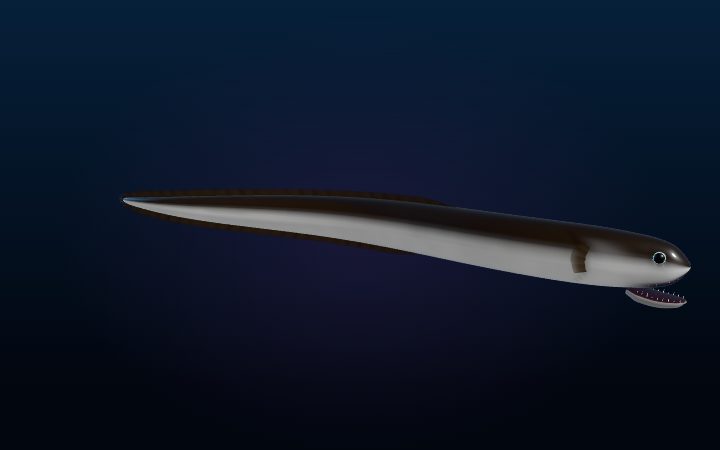
A thick, long, brownish-black eel-like body over 1 m long, small pectoral fins, dorsal and anal fins joined to the tail in one band, and small arrowhead-shaped teeth
More about this creature
Where and how deep it lives
Recorded mainly from the North Atlantic and North Pacific, and also off Durban in South Africa and in the Indo-Pacific, between about 70°N and 56°S. Its depth range is broad, about 295–5,440 m, but FishBase notes it is usually taken down to about 2,420 m, and classes it as benthopelagic, swimming in the water just above the bottom.
A 2016 autonomous-vehicle survey of fishes on the Porcupine Abyssal Plain in the northeast Atlantic (about 4,850 m) found it to be one of the common species, about 4.6% of total fish density in oblique images. Densities were roughly 13–32 individuals per square kilometre, with no clear difference between a small abyssal hill and the surrounding plain.
Food and hunting
Its estimated trophic level of about 4.2 places it high in the food web. It is also a scavenger that quickly forms dense aggregations around carrion, but in the 2016 survey it did not gather in groups when no carcass was present. Earlier baited-camera and acoustic-tracking work likewise suggested that it does not shoal or show social behaviour beyond gathering at bait.
Body and adaptations
It has an eel-shaped body with small pectoral fins and very long fins running along the rear of the body, with about 312–354 dorsal rays and about 199–245 anal rays. It has about 131–140 vertebrae. It belongs to the cutthroat eels (family Synaphobranchidae) and is thought to mature at about 35 cm (30–40 cm).
Humans and conservation
It was described by Günther in 1877 and has also been called Synaphobranchus bathybius. It is of no interest to fisheries and harmless to people. The IUCN Red List assessed it in 2011 as Data Deficient. FishBase estimates low resilience, with a minimum population doubling time of 4.5–14 years, and moderate to high vulnerability to fishing.