Brisingid sea star
Scientific name: Brisingida
The Brisingid sea star is a sea creature that lives near the seafloor at depths of about 200–6,000 m, growing to about 60 cm. In Abyss Dive you meet it at 4,100 m, in the Abyssal Zone (Abyssopelagic).
- Depth range
- about 200–6,000 m
- Max size
- about 60 cm
- Zone in this guide
- Abyssal Zone 4,000–6,000 m
- Bioluminescence
- No
- Habitat
- Near the seafloor
- Depth in the 3D dive
- 4,100 m
What is it?
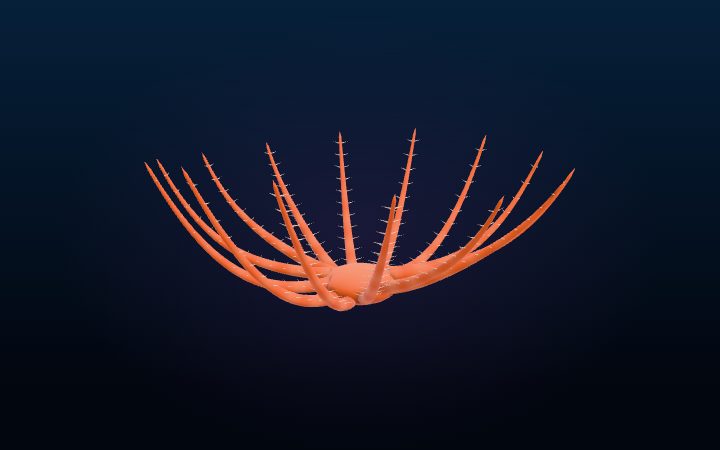
A deep-sea starfish that holds its 6 to 16 slender arms up like a basket. It lives only deeper than 200 m and has been reported down to about 6,000 m. It perches on high rocks where the current flows past.
Did you know?
Unlike ordinary sea stars that crawl along the bottom in search of food, it spreads its arms into the current and strains small drifting food out of the water with its spines.
What it looks like
A small, round disc body with 6 to 16 slender, long orange arms curving upward into a basket shape, with fine spines along each arm like the teeth of a comb
More about this creature
Where and how deep it lives
These sea stars live only in the deep sea, in the Atlantic and Pacific and around Antarctica, and are especially well known from the Caribbean and around New Zealand. The family Brisingidae has been recorded on hard bottoms at about 100–4,500 m, occurring somewhat shallower around Antarctica. On Davidson Seamount off California, an orange brisingid was photographed perched on black coral at about 1,950 m.
They are not limited to rock: during seafloor-cable surveys for an ocean observatory off Oregon, at about 600 m, large brisingids were often seen on soft sediment or sitting right on the cables.
Food and hunting
They hold their arms straight up above the disc to filter organic particles sinking from surface waters. This posture is possible because the plates on the upper side of the arms are small, letting the arms flex vertically. Within the family, Novodinia is less adept because its plates are arranged differently, and members of the other family, Freyellidae, have not been seen raising their arms this way.
Body and adaptations
The disc is small, round and stiffened by a rim of fused plates, and a deep groove sets it clearly apart from the arms, much like a brittle star's disc. The arms are long and tapering, more than six times the disc radius. Arms can be shed at the base, and the gonads sit in the part of each arm nearest the disc. Under each arm a broad groove is lined on both sides by a row of suckered tube feet, along with tiny pincer-like pedicellariae of the crossed type.
Humans and conservation
The name comes from Brísingamen, the necklace of the goddess Freya in Norse mythology, which Loki stole and hid in the sea. G. O. Sars established the family Brisingidae in 1875, and Fisher set up the order Brisingida in 1928. The order contains two families, Brisingidae and Freyellidae, and its largest genera are Freyella and Brisinga.
Sources & further reading
- Brisingida — Wikipedia en.wikipedia.org
- Brisingid Sea Stars — Interactive Oceans (UW) interactiveoceans.washington.edu
- Brisingidae — Wikipedia en.wikipedia.org