Gummy squirrel
Scientific name: Psychropotes longicauda
The Gummy squirrel is a sea creature that lives near the seafloor at depths of about 1,100–5,200 m, growing to about 60 cm. In Abyss Dive you meet it at 4,450 m, in the Abyssal Zone (Abyssopelagic).
- Depth range
- about 1,100–5,200 m
- Max size
- about 60 cm
- Zone in this guide
- Abyssal Zone 4,000–6,000 m
- Bioluminescence
- No
- Habitat
- Near the seafloor
- Depth in the 3D dive
- 4,450 m
What is it?
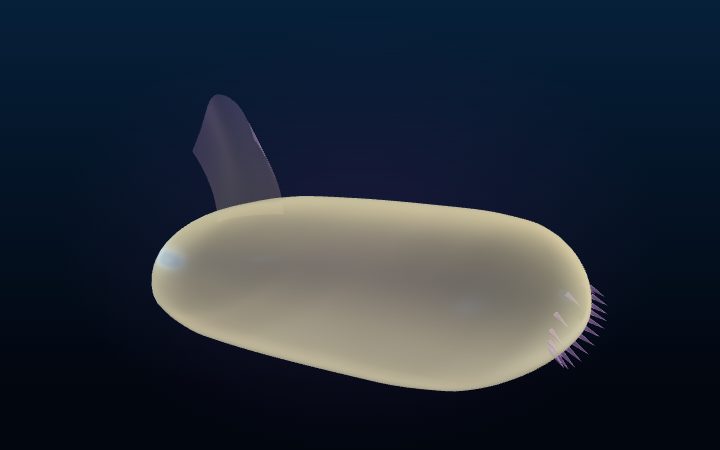
A sea cucumber that moves across the sediment of the abyssal plain. A tail-like projection rising from its back makes it look like a squirrel-shaped gummy candy. On a NOAA expedition, one about 60 cm long including the tail was seen at about 5,100 m in the Clarion-Clipperton zone of the Pacific.
Did you know?
The nickname fits: it really does look like a squirrel-shaped gummy candy. The tail-like projection is up to about 12 cm long.
What it looks like
A translucent yellow-to-purple, jelly-like, flat oval body, a sail-like tail projection rising from the rear of the back (sometimes forked at the tip), and 18 short tentacles around the mouth
More about this creature
Where and how deep it lives
It is regarded as a cosmopolitan species of the deep seafloor, and SeaLifeBase lists records from about 1,100 to 5,173 m. Adults live on soft sediment, while larvae drift more than 500 m above the bottom, though still within the abyssal zone.
Food and hunting
Its 18 short feeding tentacles end in leathery discs edged with retractable processes, which it uses to sift through sediment. NOAA footage shows the red tentacles pushed out from the front end. The larvae do not appear to feed.
Body and adaptations
The body is a very flexible cylinder, broadest and slightly flattened near the front. Museum specimens put adult length at about 14–32 cm, smaller than the roughly 60 cm animal (tail included) that NOAA observed. The tail-like dorsal appendage is either pointed or split into two unequal tips. Small tube feet form a double row underneath, with a single row of larger ones along each side; the skin is soft, and preserved specimens are violet.
Life cycle and behaviour
Its eggs, about 4.4 mm across, are the largest of any echinoderm. The rich yolk lets the larvae go a long time without feeding, so they can spread far. The larvae have ten tentacles, a transparent body tinged red at the front, and a gelatinous dorsal appendage nearly as long as the body that may work like a sail.
Humans and conservation
Johan Hjalmar Théel described it in 1882, and several forms later described under other names, including P. brucei, P. grimaldii and Euphronides dyscrita, have been merged into it. NOAA's 2018 DeepCCZ expedition recorded at least ten species of giant sea cucumbers in two areas of the Clarion-Clipperton Zone set aside from mining, and this species was photographed on that survey. It has not been evaluated by the IUCN.
Sources & further reading
- Psychropotes longicauda — Wikipedia en.wikipedia.org
- Psychropotes longicauda — SeaLifeBase www.sealifebase.se
- Gummy squirrel sea cucumber, 2018 DeepCCZ expedition — NOAA Ocean Exploration oceanexplorer.noaa.gov