Highfin lizardfish
Scientific name: Bathysaurus mollis
The Highfin lizardfish is a sea creature that lives near the seafloor at depths of about 1,550–4,903 m, growing to about 78 cm. In Abyss Dive you meet it at 4,050 m, in the Abyssal Zone (Abyssopelagic).
- Depth range
- about 1,550–4,903 m
- Max size
- about 78 cm
- Zone in this guide
- Abyssal Zone 4,000–6,000 m
- Bioluminescence
- No
- Habitat
- Near the seafloor
- Depth in the 3D dive
- 4,050 m
What is it?
A lizardfish found in water colder than 4°C on the continental rise and abyssal plains. It lies alone on the bottom, mostly deeper than 2,000 m, waiting for fish to pass.
Did you know?
Each individual has both male and female reproductive organs (a hermaphrodite), which helps it breed in the deep sea, where mates are scarce.
What it looks like
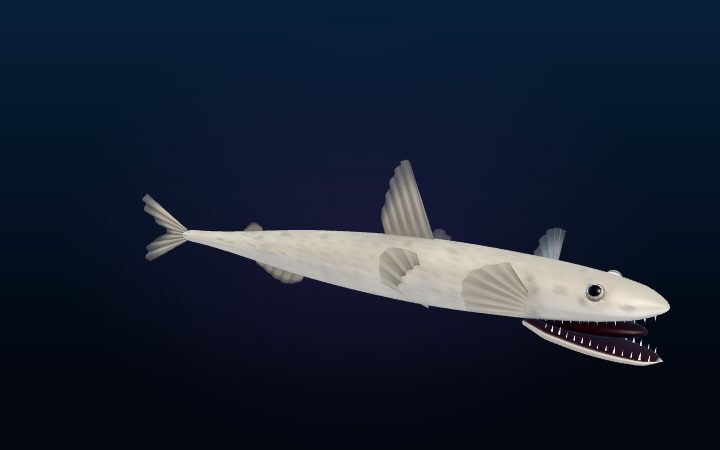
A long, cylindrical, light-gray body, a flat, lizard-like big head with a wide mouth full of needle teeth, a tall dorsal fin, and pectoral and pelvic fins propped against the bottom
More about this creature
Where and how deep it lives
It is found around the world between 50°N and 20°S, except in the tropical eastern Pacific. In the eastern Atlantic it is known off northern Ireland and from Morocco to Gabon. The lower limit of its depth range is still unknown.
Food and hunting
FishBase considers it probably a fish-eater. Across its genus, Bathysaurus, the main prey are bottom-living fishes and large decapod crustaceans such as shrimps and crabs.
Body and adaptations
The body is moderately long and slender, slightly flattened from top to bottom at the front and from side to side towards the tail. It is mostly white to light grey, but the lining of the body cavity, the gill area and the inside of the mouth are dark; the flesh is flabby and the skin translucent. Juveniles and small adults keep faint bars left over from the larval pattern.
Like others in its genus it has a flattened head and a very large mouth, with the upper jaw reaching well behind the eye, and rows of long, sharp, hinged teeth, many of which stick out even when the mouth is closed. Even the gill rakers are turned into clusters of short, sharp teeth. It is told apart from its relative B. ferox by having an adipose fin, unbranched central pectoral rays and soft flesh.
Life cycle and behaviour
Submersible observations show fish of this genus resting on the bottom with the head slightly raised on the pelvic fins, then bursting away at speed when disturbed. The larvae, known as 'Macristium', drift in midwater near the surface and grow to about 110 mm. FishBase treats the species as a hermaphrodite, correcting an earlier reference that said otherwise.
Humans and conservation
Albert Günther described it in 1878. A 1985 study by Sulak and colleagues reviewed the life history and classification of the genus, then placed in the lizardfish family Synodontidae; it is now treated as a separate family, Bathysauridae. It has no fisheries value and is rated Least Concern on the IUCN Red List.
Sources & further reading
- Bathysaurus mollis — FishBase www.fishbase.se
- Genus Bathysaurus — Fishes of the NE Atlantic and Mediterranean (Naturalis) fishes-fnam.linnaeus.naturalis.nl
- Bathysaurus mollis — NCFishes ncfishes.com