Scavenging deep-sea amphipod
Scientific name: Eurythenes gryllus
The Scavenging deep-sea amphipod is a sea creature that lives in open water at depths of about 550–7,800 m, growing to about 15 cm. In Abyss Dive you meet it at 4,900 m, in the Abyssal Zone (Abyssopelagic).
- Depth range
- about 550–7,800 m
- Max size
- about 15 cm
- Zone in this guide
- Abyssal Zone 4,000–6,000 m
- Bioluminescence
- No
- Habitat
- Open water (swimming)
- Depth in the 3D dive
- 4,900 m
What is it?
A large amphipod common near the bottom in cold, deep seas worldwide. It grows to about 15 cm long and lives as deep as 7,800 m, inside trenches.
Did you know?
It's remarkably good at following a smell from far away, so when a carcass hits the bottom, many individuals converge on it almost at once.
What it looks like
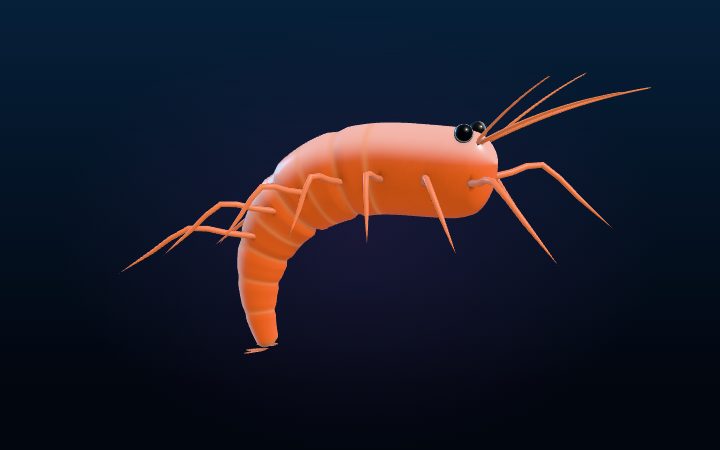
An orange-to-red shrimp-like body, flattened from the side and curved in an arc, with jointed layers of back plates, two pairs of long antennae, and several pairs of thin legs
More about this creature
Where and how deep it lives
A bottom-associated amphipod recorded at about 550–7,800 m. Genetic studies, however, have shown it to be a cryptic species complex split by region and by depth, with the main division between shallow and deep forms at about 3,000 m. If each lineage were recognised as a species, the true Eurythenes gryllus would be the widespread shallow lineage living at about 800–2,750 m in Arctic and Antarctic waters.
Food and hunting
It is a fast-swimming predator and scavenger. Its long-range ability to track scent lets large numbers gather quickly when a carcass lands, which is why it turns up so often in baited traps and baited cameras. Later work showed that this reliance on food sinking from above also links it to pollution.
Body and adaptations
It is red, brown or pale, with white eyes. It grows to about 15 cm, and individuals from shallow water reach only about half the length of those from the greatest depths. Its genus, Eurythenes, includes some of the largest scavenging amphipods of the deep sea and occurs in every ocean, from shallow polar water to hadal depths.
Humans and conservation
It was first described in 1822 as Gammarus gryllus. A 2013 PLOS ONE study by Havermans and colleagues analysed genetic and morphological divergence and exposed the cryptic-species problem, and in 2020 a ninth species of the genus, E. plasticus, was described from the Mariana Trench.
A 2019 study of 90 amphipods from six Pacific Rim trenches (about 7,000–10,890 m) included this species from the Peru-Chile Trench. About 72% of all animals (65 of 90) had swallowed at least one microparticle, and one fibre from about 7,050 m in the Peru-Chile Trench was identified as a polyethylene-coated polyester strand.
Sources & further reading
- Eurythenes gryllus — Wikipedia en.wikipedia.org
- Microplastics and synthetic particles ingested by deep-sea amphipods in six of the deepest marine ecosystems on Earth (Jamieson et al. 2019) — PMC pmc.ncbi.nlm.nih.gov
- Eurythenes plasticus sp. nov. (2020) — Novataxa novataxa.blogspot.com