Giant sea spider
Scientific name: Colossendeis colossea
The Giant sea spider is a sea creature that lives near the seafloor at depths of about 420–5,200 m, growing to about 70 cm. In Abyss Dive you meet it at 4,600 m, in the Abyssal Zone (Abyssopelagic).
- Depth range
- about 420–5,200 m
- Max size
- about 70 cm
- Zone in this guide
- Abyssal Zone 4,000–6,000 m
- Bioluminescence
- No
- Habitat
- Near the seafloor
- Depth in the 3D dive
- 4,600 m
What is it?
The largest sea spider, with a leg span of about 70 cm. It looks like a spider but belongs to a different group of marine arthropods. It lives in deep waters worldwide except the Arctic Ocean.
Did you know?
Its body is so slender that its gut extends into the legs. With no gills, it takes in oxygen through its leg surfaces, and the writhing gut carries that oxygen around the body.
What it looks like
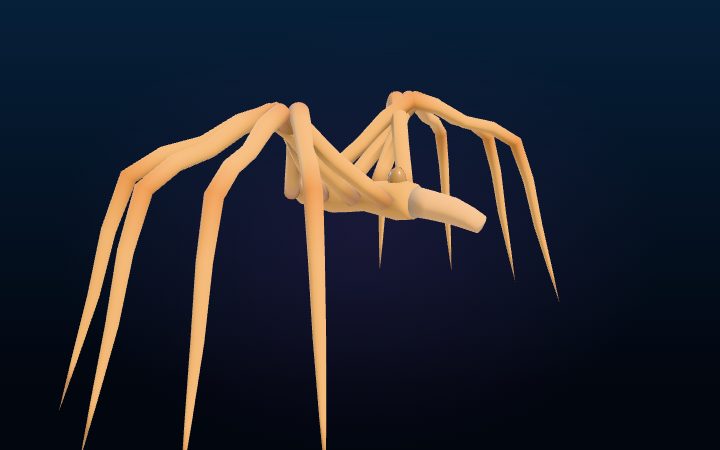
A small orange body as thin as a pencil, eight jointed legs several times longer than the body planted on the bottom, and a long tube-shaped proboscis at the front
More about this creature
Where and how deep it lives
A bottom-living sea spider of continental slopes and the deep floor below them, recorded at roughly 420–5,200 m. The SeaLifeBase database notes that it is usually found at about 1,000–2,500 m. It has been recorded from tropical to polar seas, and the first record from the western Indian Ocean was published in 2016.
Food and hunting
SeaLifeBase lists sea anemones as its food. Sea spiders in general feed on soft-bodied invertebrates such as cnidarians, sponges, polychaetes and bryozoans by pushing the proboscis into the prey. Because most anemones survive the encounter, sea spiders are sometimes described as parasites of anemones rather than predators.
Body and adaptations
Its body, including proboscis and abdomen, is only up to about 7 cm long; the very long, slender legs make up most of the animal. The proboscis is swollen in the middle. In sea spiders, branches of the gut run deep into the legs, and so do branches of the gonads.
In 2017 a University of Montana team used video microscopy on 12 sea spider species and reported in Current Biology that the heart only weakly circulates blood in the central body, while strong peristaltic waves of the gut drive circulation in the legs. The work grew out of research on polar gigantism, with fieldwork at McMurdo Station in Antarctica. The press release does not say whether this particular species was among those studied.
Life cycle and behaviour
The sexes are separate and look different. In most sea spiders the male hangs beneath the female during mating, and the male then carries the egg masses on special appendages called ovigers until they hatch. The family Colossendeidae, however, is described as an exception that leaves egg masses on the substrate, so how this species actually reproduces is uncertain. The eggs hatch into a larva called a protonymphon.
Humans and conservation
It was described in 1881 by Edmund B. Wilson from material dredged off the U.S. East Coast in 1880 by the Coast Survey steamer Blake. More than 1,300 sea spider species in over 80 genera are known, most of them small shallow-water animals. This species has not been evaluated for the IUCN Red List and has no known fisheries value.
Sources & further reading
- Colossendeis colossea — Wikipedia en.wikipedia.org
- Giant sea spiders use their legs as gills and their guts as hearts — University of Hawaiʻi www.hawaii.edu
- Colossendeis colossea — SeaLifeBase sealifebase.se
- Sea spider — Wikipedia en.wikipedia.org
- Sea spiders move oxygen with their guts, not their hearts (2017) — ScienceDaily www.sciencedaily.com