Pudgy cuskeel
Scientific name: Spectrunculus grandis
The Pudgy cuskeel is a sea creature that lives in open water at depths of about 800–4,300 m, growing to about 1.3 m. In Abyss Dive you meet it at 3,900 m, in the Midnight Zone (Bathypelagic).
- Depth range
- about 800–4,300 m
- Max size
- about 1.3 m
- Zone in this guide
- Midnight Zone 1,000–4,000 m
- Bioluminescence
- No
- Habitat
- Open water (swimming)
- Depth in the 3D dive
- 3,900 m
What is it?
A plump cusk-eel that lives near the bottom, on the lower continental slope and near abyssal plains. It's seen mostly at 2,000–3,000 m, feeding on crustaceans, snails, bristle-worm scraps and organic matter on the bottom.
Did you know?
It lays its eggs in a jelly mass and lets them float away.
What it looks like
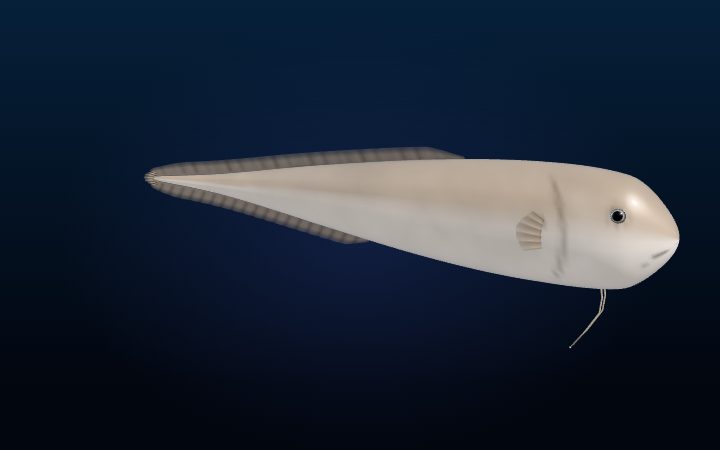
A thick, light-brown body a little over 1 m long that tapers toward the rear, dorsal and anal fins joined to the tail in one continuous band, small eyes, and thin thread-like pelvic fins under the chin
More about this creature
Where and how deep it lives
It ranges through the Atlantic and Pacific from about 57°N to 59°S and is described as a common fish of deep oceans worldwide. FishBase gives a depth range of about 800–4,300 m, while another source records it down to about 4,800 m. Atlantic fish tend to be pale, Pacific ones darker.
Body and adaptations
Reaching about 127 cm and 5.4 kg, it is among the largest bony fishes living below 2,000 m. The body is elongated, and the rounded snout bears a single fleshy front nostril ahead of a flat rear one. Its fins have no spines; a dorsal fin of 135–148 rays and an anal fin of 101–112 rays run far back along the body. Colour varies from pale with white fins to light or dark brown, and males are larger and darker than females.
Life cycle and behaviour
It lays oval eggs that float in masses, and the larvae drift as plankton. Basic life-history data such as size at maturity and lifespan are not yet available even in FishBase.
Humans and conservation
Günther described it in 1877, and it has since been shuffled between genera under names such as Bassogigas grandis and Neobythites grandis. In 2008 a similar species, S. crassus, was split off, leaving two species in the genus.
It is taken in minor commercial fisheries. FishBase rates its vulnerability to fishing as high to very high (72 of 100) and its resilience as very low, with a population doubling time of over 14 years. The IUCN lists it as Least Concern.
Sources & further reading
- Spectrunculus grandis — FishBase www.fishbase.se
- Spectrunculus grandis — Wikipedia en.wikipedia.org