Antarctic krill
Scientific name: Euphausia superba
The Antarctic krill is a bioluminescent (light-making) sea creature that lives in open water at depths of about 0–3,000 m, growing to about 6 cm. In Abyss Dive you meet it at 70 m, in the Sunlight Zone (Epipelagic).
- Depth range
- about 0–3,000 m
- Max size
- about 6 cm
- Zone in this guide
- Sunlight Zone 0–200 m
- Bioluminescence
- Yes
- Habitat
- Open water (swimming)
- Depth in the 3D dive
- 70 m
What is it?
A finger-length crustacean that forms enormous swarms in the Southern Ocean. Whales, seals, penguins and most of the Antarctic ecosystem depend on it. Its eggs sink to 2,000–3,000 m before the hatched larvae swim back up.
Did you know?
The combined weight of all Antarctic krill is estimated at about 500 million tonnes, making it one of the most abundant animal species on Earth. It has light-producing organs on its eyestalks, legs and abdomen.
What it looks like
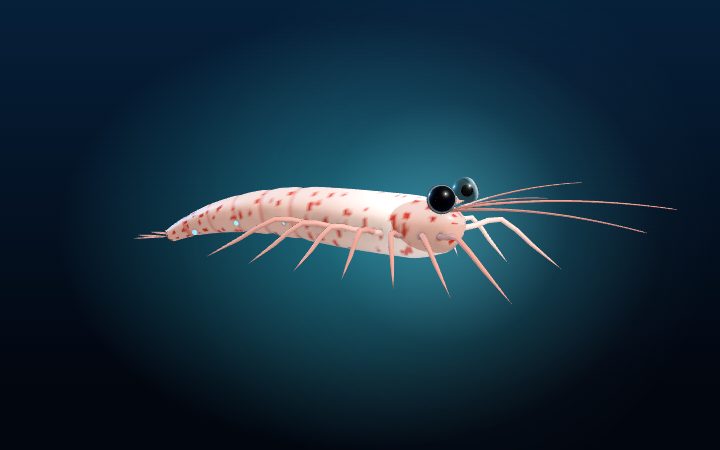
A translucent shrimp-like body about 6 cm long with red spots, big black eyes, feathery bundles of legs under the chest, and tiny blue light organs under the eyestalks and abdomen
More about this creature
Where and how deep it lives
It ranges throughout the Southern Ocean south of the Antarctic Convergence, at about 55°S, in water of roughly −1.3 to 3 °C. The densest concentrations are in the Scotia Sea near the Antarctic Peninsula. Swarms can hold 10,000–30,000 animals per cubic metre, and one swarm spanning 450 km² and 200 m deep was estimated to contain more than 2 million tonnes. Large swarms can turn the sea reddish-brown.
Krill feed near the surface at night and sink deeper by day, and are thought to make one to three vertical migrations daily, down to around 100 m.
Food and hunting
Its main food is phytoplankton, especially small diatoms about 20 µm across. The feeding basket formed by its thoracic legs has openings as small as 1 µm, fine enough to catch very small cells. It also eats small zooplankton such as copepods and amphipods.
Krill also scrape algae from the underside of sea ice; a single animal can clear an area about 30 cm by 30 cm in roughly ten minutes. In winter, when food is scarce, they get by on under-ice algae, detritus on the seafloor and other animals.
Body and adaptations
Adults are about 6 cm long and weigh 1–2 g. Their light organs emit a yellow-green glow lasting two to three seconds. When threatened, a krill reacts in about 55 milliseconds and flicks itself backwards at more than 0.6 m per second.
It moults every 13 to 20 days, and when food runs out it shrinks with each moult, burning its own body protein for fuel; in the laboratory, krill have survived more than 200 days of starvation. Because the eyes do not shrink, the ratio of eye size to body size reveals how hungry an animal has been.
Life cycle and behaviour
Spawning runs roughly from January to March, and a female releases several batches of thousands to about 10,000 eggs. The eggs sink, and the larvae that hatch take about three weeks to rise back towards the surface, passing through nauplius, calyptopis and furcilia stages. Krill mature in about two to three years. They are thought to live more than five years, but they are hard to age, and estimates range from up to six to as many as ten years.
Humans and conservation
The catch is on the order of 100,000 tonnes a year, led by South Korea, Norway, Japan and Poland, and is used mainly for animal feed and fishing bait. The Australian Antarctic Division puts total Southern Ocean biomass at about 400 million tonnes, while another estimate is about 500 million tonnes. The division's laboratory at Kingston runs the only aquarium in the world where the entire life cycle of Antarctic krill can be studied.
Crabeater seals rely on krill for about 98% of their diet, and Antarctic predators are estimated to eat around 150–310 million tonnes of krill a year. Krill release fast-sinking faecal strings that carry carbon to the deep sea, where it can stay locked away for about 1,000 years. Studies have linked declining sea ice to fewer krill and more salps, and rising carbon dioxide may disrupt the development of krill eggs.
Sources & further reading
- Antarctic krill — Wikipedia en.wikipedia.org
- Krill — Australian Antarctic Program www.antarctica.gov.au