Leatherback sea turtle
Scientific name: Dermochelys coriacea
The Leatherback sea turtle is a sea creature that lives in open water at depths of about 0–1,280 m, growing to about 2.7 m. In Abyss Dive you meet it at 85 m, in the Sunlight Zone (Epipelagic).
- Depth range
- about 0–1,280 m
- Max size
- about 2.7 m
- Zone in this guide
- Sunlight Zone 0–200 m
- Bioluminescence
- No
- Habitat
- Open water (swimming)
- Depth in the 3D dive
- 85 m
What is it?
The largest living sea turtle. Instead of a hard shell, its back is covered in leathery skin. It eats almost nothing but jellyfish and travels thousands of kilometers across the ocean.
Did you know?
Recorded diving to about 1,280 m, it's considered the deepest-diving reptile.
What it looks like
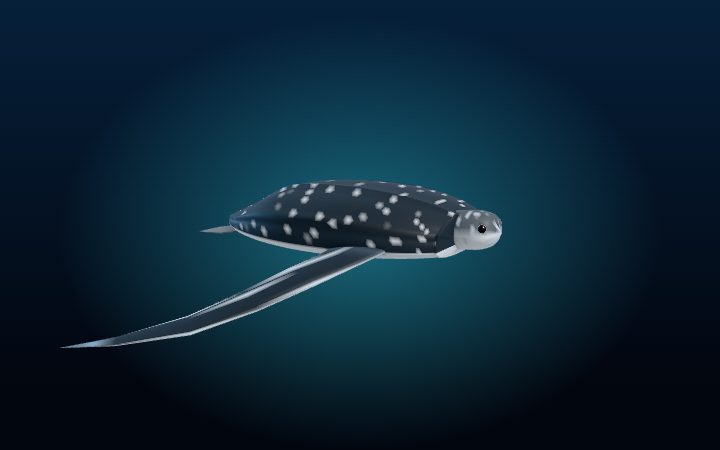
A teardrop-shaped black back narrowing toward the rear, with seven lengthwise ridges and white spots, winglike front flippers as long as the body, and small rear flippers
More about this creature
Where and how deep it lives
It lives in tropical and subtropical waters of the Atlantic, Pacific and Indian oceans, but ranges north to Alaska, Norway and into the Arctic Circle, and south to Cape Agulhas in South Africa and the southern tip of New Zealand. Genetically, there are three main populations: Atlantic, eastern Pacific and western Pacific. One turtle swam about 20,000 km over 647 days from Indonesia to the United States, and western Pacific leatherbacks make a trans-Pacific crossing of roughly 11,000 km lasting 10–12 months.
Dives usually last three to eight minutes, but it has stayed under for up to about 85 minutes and pursues prey deeper than 1,000 m.
Food and hunting
Jellyfish dominate its diet, but it also eats siphonophores, salps, pyrosomes, squid, crustaceans, fish and algae. Adults have been reported to eat about 73% of their body weight a day. It has no teeth, but the edge of its upper jaw is sharply pointed, and backward-pointing spines line its throat so slippery prey cannot escape.
Body and adaptations
Instead of a hard bony shell, its back is covered with thick, leathery skin over a layer of tiny interlocking bones (osteoderms). This arrangement flexes without cracking, which helps it withstand the pressure of deep dives. Seven ridges run lengthwise down its back towards the tail.
Although it is a reptile, it can keep its core temperature up to about 18 °C above the surrounding water. Brown fat, countercurrent heat exchangers between the front flippers and the body, and a network of heat exchangers around the windpipe all help retain heat, which comes mainly from constant muscle activity rather than a high resting metabolism. One turtle was recorded hunting in water of 0.4 °C and then returning to 17.5 °C surface water to warm up.
Life cycle and behaviour
Mating takes place at sea, and every two to four years females return to beaches with soft sand and access to deep water to lay their eggs at night. They nest several times in a season, about every 8–12 days, laying roughly 100 eggs per clutch. The eggs hatch after about two months, and nest temperature determines the hatchlings' sex.
According to NOAA, leatherbacks mature at roughly 9–20 years and live an estimated 45–50 years or more. A 2020 genetics-based estimate put their lifespan at about 90 years.
Humans and conservation
The IUCN Red List classes the species overall as Vulnerable (2013 assessment), but the East Pacific, West Pacific, Southwest Atlantic and Southwest Indian Ocean subpopulations are Critically Endangered. The eastern Pacific population has declined by more than 97% over three generations, and the western Pacific population by more than 80%. In Malaysia, nesting fell from about 10,000 nests in 1953 to one or two a year at most since 2003.
Bycatch in fishing gear is the biggest threat, followed by harvesting of turtles and eggs, loss of nesting beaches, ship strikes and marine debris. Leatherbacks often mistake plastic bags for jellyfish, and about a third of adults are estimated to have swallowed plastic, while artificial lights on beaches lure hatchlings away from the sea. The US requires turtle excluder devices in shrimp trawls and closes waters off California to drift gillnets every year from 15 August to 15 November.
Sources & further reading
- Leatherback sea turtle — Wikipedia en.wikipedia.org
- Leatherback Turtle — NOAA Fisheries www.fisheries.noaa.gov