Orca (Killer whale)
Scientific name: Orcinus orca
The Orca (Killer whale) is a sea creature that lives in open water at depths of about 0–300 m, growing to about 9.8 m. In Abyss Dive you meet it at 28 m, in the Sunlight Zone (Epipelagic).
- Depth range
- about 0–300 m
- Max size
- about 9.8 m
- Zone in this guide
- Sunlight Zone 0–200 m
- Bioluminescence
- No
- Habitat
- Open water (swimming)
- Depth in the 3D dive
- 28 m
What is it?
The apex predator of the sea, with bold black-and-white markings. Orcas live in family pods, and each pod has its own hunting methods and vocal 'dialect'. They stay mostly near the surface but may dive hundreds of meters, depending on their prey.
Did you know?
Despite the 'whale' in its common name, it's the largest member of the dolphin family.
What it looks like
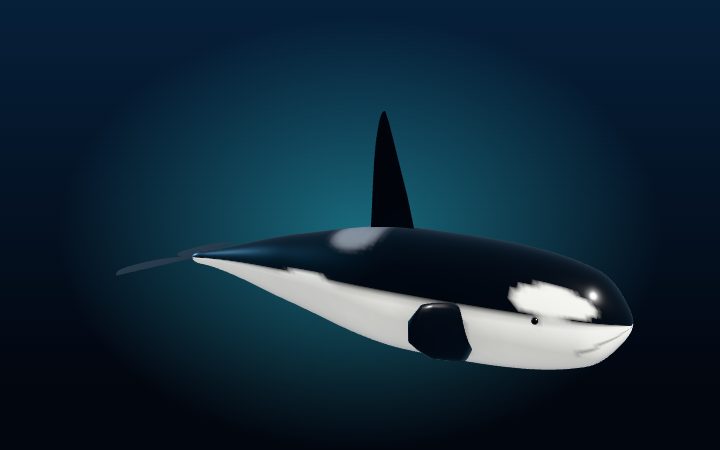
A stout, spindle-shaped black body, a white belly and an oval white patch behind each eye, a tall triangular dorsal fin in the middle of the back (over 1 m in males), and paddle-shaped pectoral fins
More about this creature
Where and how deep it lives
Orcas occur in every ocean and most seas, with a preference for high latitudes and coastal waters. Densities are highest off Norway, along the Aleutian Islands and Gulf of Alaska, and around Antarctica. The world population was put at a minimum of about 50,000 in 2006, roughly 25,000 of them in Antarctic waters.
Within the species, regional 'ecotypes' differ in diet and behaviour. Off western North America there are fish-eating residents, mammal-eating transients (Bigg's orcas) and offshore orcas that take fish including sharks, while Antarctic waters hold Types A to D. A 2024 study proposed raising residents and transients to full species, but the Society for Marine Mammalogy provisionally keeps them as subspecies.
Food and hunting
Fish-eating orcas take about 30 fish species; for northeast Pacific residents, 96% of the diet is salmon, and 65% of that is Chinook. In Norway, orcas herd herring into a tight ball and slap it with their tails, stunning up to 15 fish at a time, while Antarctic Type B orcas work together to make waves that wash Weddell seals off ice floes.
At Península Valdés in Argentina and the Crozet Islands, orcas deliberately beach themselves to grab sea lions and elephant seals, a skill that is learned rather than instinctive and can take young animals years to master. Some groups flip great white sharks onto their backs to induce tonic immobility. On average an orca eats about 227 kg of food a day.
Body and adaptations
Males are 6–8 m long and weigh over 6 tonnes; females are 5–7 m and 3–4 tonnes, with record lengths of about 10 m for males and 8.5 m for females. A male's dorsal fin stands about 1.8 m tall, more than twice the height of a female's. Even a newborn calf is about 2.4 m long and 180 kg. Orcas have highly sophisticated echolocation based on clicks, and their brain is the second heaviest among marine mammals after the sperm whale's.
Life cycle and behaviour
Among residents, the basic unit is a matriline averaging about 5.5 animals, and up to six generations may travel together. One to four matrilines make up a pod, and pods that share a dialect form a clan. A resident dialect contains 7–17 call types (11 on average), and mates are usually found in other pods.
Females mature at 10–13, breed until about 40 and then go through menopause, something very few animals do. Gestation lasts 15–18 months and a mother typically has one calf about every five years, but 37–50% of calves die within their first seven months. According to NOAA, wild males live about 30 years on average (60 or more at most) and females about 50 (90 or more at most).
Humans and conservation
In 2008 the IUCN moved the orca to Data Deficient, because several of its types may be separate species. The Southern Resident population off Washington State was listed as endangered under the US Endangered Species Act in 2005; it peaked at 98 animals in 1995 and numbered 74 in the July 2025 census.
The main threats are shrinking prey such as Chinook salmon, contaminants such as PCBs that build up through the food web, and vessels and noise. With boats nearby, orcas hunt less and travel more, and in noisy water they call louder, spending more energy. Captive orcas have injured or killed trainers, but no fatal attack on a person has been recorded in the wild.
Sources & further reading
- Orca — Wikipedia en.wikipedia.org
- Killer Whale — NOAA Fisheries www.fisheries.noaa.gov