Ocean sunfish
Scientific name: Mola mola
The Ocean sunfish is a sea creature that lives in open water at depths of about 0–1,515 m, growing to about 3.3 m. In Abyss Dive you meet it at 50 m, in the Sunlight Zone (Epipelagic).
- Depth range
- about 0–1,515 m
- Max size
- about 3.3 m
- Zone in this guide
- Sunlight Zone 0–200 m
- Bioluminescence
- No
- Habitat
- Open water (swimming)
- Depth in the 3D dive
- 50 m
What is it?
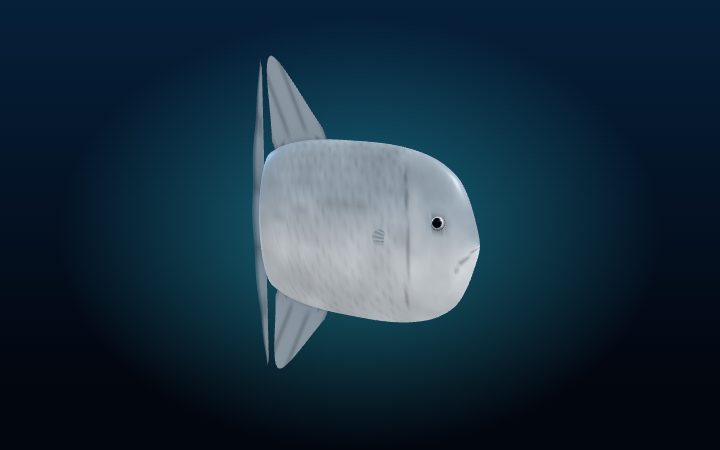
A giant disc-shaped fish that looks as if its back half has been chopped off, with a rudder-like 'clavus' where a tail fin should be. It often floats on its side at the surface, but it's also an active swimmer, recorded as deep as 1,500 m.
Did you know?
One 1.5 m female was found carrying about 300 million eggs, making the sunfish one of the most prolific egg-layers known.
What it looks like
A flat, silver-gray disc that is as tall as it is long when seen from the side, with a tall dorsal fin and anal fin pointing up and down, a short wavy rudder at the rear instead of a tail, and a small round mouth
More about this creature
Where and how deep it lives
It lives in tropical and temperate waters of every ocean, with records from 75°N to 65°S. Known for floating at the surface, adults in fact spend much of their time hunting below 200 m. It is usually found in water warmer than 10 °C, and long spells in water of 12 °C or colder can leave it disoriented and eventually kill it.
Lying on its side at the surface is thought to be a way of warming back up after feeding in deep, cold water. One individual was tracked swimming 26 km in a day at a cruising speed of about 3.2 km/h, contradicting the old idea that it simply drifts with the currents.
Food and hunting
It was long thought to eat mainly jellyfish and other gelatinous zooplankton, but genetic analysis showed jellyfish and salps make up only about 15% of its diet. It is a generalist that takes small fish and fish larvae, squid and other molluscs, crustaceans and even brittle stars, occasionally eats eelgrass, and forages at many depths, sometimes down to the seafloor.
Body and adaptations
The tail fin has been lost over its evolution; in its place a rounded clavus, formed where the dorsal and anal fins converge, serves as a rudder. Thrust comes from sculling the tall dorsal and anal fins from side to side. Instead of a swim bladder it has a thick gelatinous layer that is about 90% water, and its skeleton is largely cartilage, which keeps the body light.
Its teeth are fused into a beak, so it cannot fully close its mouth, and it has separate pharyngeal teeth in its throat. In place of scales, its skin is covered with tiny denticles and mucus, and on the belly it can be up to 7.3 cm thick.
Life cycle and behaviour
Eggs are fertilised outside the body, and newly hatched larvae are just 2.5 mm long and weigh less than a gram. Survivors can grow to as much as 60 million times their starting weight, possibly the most extreme growth of any vertebrate. A young sunfish at Monterey Bay Aquarium went from 26 kg to 399 kg in 15 months. In the wild, females are estimated to live about 2–23 years and males about 1–16.
More than 40 parasite species may live on or in a sunfish. In temperate waters, cleaner wrasses sheltering in drifting kelp pick them off; in the tropics, reef fish do the job; and when it lies at the surface, seabirds peck them away. Young sunfish fall prey to bluefin tuna and mahi-mahi, adults to orcas, sharks and sea lions.
Humans and conservation
The IUCN Red List classes it as Vulnerable, and the main threat is drift gillnets. Sunfish have made up nearly 30% of the catch in California's drift-gillnet swordfish fishery and 71–90% in Mediterranean swordfish fisheries. Some fishers cut the fins off sunfish they consider worthless, leaving them unable to swim, and they eventually die.
Taiwan and Japan are the largest markets for sunfish meat, eaten as a delicacy, but the European Union bans sunfish products over concerns about toxins. Claims that its organs contain tetrodotoxin are disputed. It is difficult to keep in captivity, though one individual at Kamogawa Sea World in Japan lived for 2,993 days, growing from 72 cm to 187 cm.
Sources & further reading
- Mola mola — FishBase www.fishbase.se
- Ocean sunfish — Wikipedia en.wikipedia.org