Giant oarfish (King of herrings)
Scientific name: Regalecus glesne
The Giant oarfish (King of herrings) is a sea creature that lives in open water at depths of about 20–1,000 m, growing to about 8 m. In Abyss Dive you meet it at 190 m, in the Sunlight Zone (Epipelagic).
- Depth range
- about 20–1,000 m
- Max size
- about 8 m
- Zone in this guide
- Sunlight Zone 0–200 m
- Bioluminescence
- No
- Habitat
- Open water (swimming)
- Depth in the 3D dive
- 190 m
What is it?
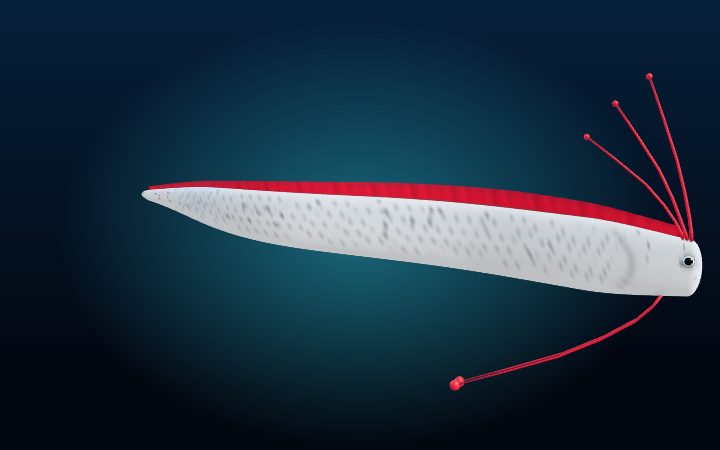
A bony fish with a long, flat, ribbon-like silver body and a red dorsal fin running from head to tail. It's thought to hang vertically in the water, head up, watching for the silhouettes of prey passing overhead.
Did you know?
The longest bony fish, reaching about 8 m. It appears to break off the rear part of its own body several times over its life.
What it looks like
A very long, low, flat silver ribbon of a body, a red dorsal fin from head to tail, a long red crest of fin rays rising above the head, and a pair of long, oar-shaped pelvic fins
More about this creature
Where and how deep it lives
It has been recorded throughout the world's oceans except the polar regions, from 72°N to 52°S, and an isolated breeding population lives in the Mediterranean. FishBase gives a depth range of 20–1,000 m (mostly 20–200 m), but the deepest verified observation is about 460–490 m in the Gulf of Mexico. No one has ever estimated its total population.
Food and hunting
It feeds by thrusting out its toothless jaws to suck in krill-laden water, and its known prey includes euphausiids (krill), small fish and squid. Most stomachs examined, however, have been empty or held only coloured fluid, so its feeding habits remain poorly understood.
Body and adaptations
The dorsal fin has 414–449 soft rays, the first 10–12 forming a red crest. The long, oar-shaped pelvic fins are thought to be the origin of the name 'oarfish'. It has no anal fin and only stubby pectoral fins, scaleless skin dotted with small tubercles, large eyes and a toothless mouth. It also lacks a swim bladder.
Its organs are packed towards the head, so losing the rear of the body does not damage anything vital; every individual longer than 1.5 m has been found with a shortened tail. A commonly measured length is about 3 m, and the heaviest on record weighed 272 kg.
Life cycle and behaviour
It spawns between July and December by releasing eggs and sperm into open water, with no parental care, and its larvae are found near the surface. The eggs are round and covered in short spines, and the larvae have mostly transparent skin with dark spots. Juveniles start with a single crest ray, and the crest becomes more elaborate as they grow.
Oarfish have been seen in pairs, but never in groups larger than three. No natural predators are documented; a pod of pilot whales once attacked one but did not eat it.
Humans and conservation
Footage shot by a remotely operated vehicle in the Gulf of Mexico in 2010 was the first reliably identified recording of the species in its natural habitat. Large adults occasionally wash ashore, sometimes clustered in particular places and seasons. It is not fished commercially, though it is caught occasionally as bycatch, and its flesh has been described as tasting 'like paper'.
It is presumed to lie behind some sea serpent sightings. Folklore casts it as a fish that foretells earthquakes, but no real correlation has been supported. The IUCN Red List classes it as Least Concern (assessed 2013).
Sources & further reading
- Regalecus glesne — FishBase www.fishbase.se
- Giant oarfish — Wikipedia en.wikipedia.org