Sea angel (Naked sea butterfly)
Scientific name: Clione limacina
The Sea angel (Naked sea butterfly) is a sea creature that lives in open water at depths of about 0–500 m, growing to about 9 cm. In Abyss Dive you meet it at 40 m, in the Sunlight Zone (Epipelagic).
- Depth range
- about 0–500 m
- Max size
- about 9 cm
- Zone in this guide
- Sunlight Zone 0–200 m
- Bioluminescence
- No
- Habitat
- Open water (swimming)
- Depth in the 3D dive
- 40 m
What is it?
A shell-less, translucent sea snail that drifts along rowing a pair of small wings. It lives in cold seas, and with those wings it looks like a tiny angel, hence the name.
Did you know?
Its looks are deceiving: it's a hunter. It extends three pairs of tentacle-like mouth organs from its head to grab sea butterflies, then uses hooks to pull the whole body out of the shell.
What it looks like
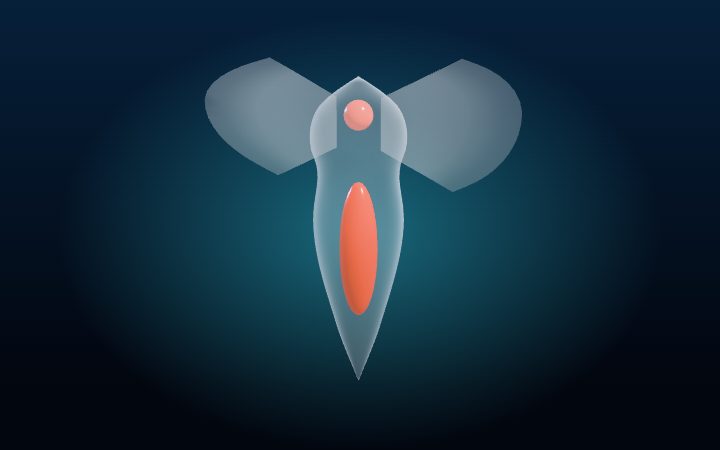
A transparent, droplet-shaped body a few cm long, a pair of small translucent wings on either side of the head, and an orange-to-red gut showing through the middle of the body
More about this creature
Where and how deep it lives
It lives in the cold waters of the Arctic and North Atlantic, ranging south at least to the Sargasso Sea, from the surface to depths greater than 500 m. Similar sea angels from the North Pacific, the Sea of Okhotsk and Antarctica were once included in this species but are now treated as separate species.
Food and hunting
Adults feed almost exclusively on two sea butterflies, Limacina helicina and L. retroversa. When it strikes, the buccal cones on each side of its head inflate in an instant to grip the prey; its heart rate rises during feeding, which may help inflate the cones hydraulically and speed up swimming. Young larvae feed on phytoplankton before switching to Limacina, and large adults avoid small Limacina.
It is remarkably tolerant of starvation and can go a year without food; in lab starvation trials, average length shrank from 22.4 mm to 12 mm. During a period with no adult Limacina around, 24 of 138 animals examined had amphipods in their stomachs and 3 had copepods.
Body and adaptations
The northern subspecies matures at about 3 cm and reaches 7–8.5 cm, making it by far the largest sea angel, whereas the southern subspecies grows to only about 1.2 cm. Two statocysts, gravity-sensing organs, keep it upright, with the tail used to correct its posture.
In slow swimming it hangs vertically, head up, rowing its wings to hold its depth. For hunting or escape it shifts into a separate fast 'gear', recruiting large motor neurons that drive both slow- and fast-twitch fibres across the whole wing. A touch to the front of the body or the wings makes it pull in its head, wings and tail and stop swimming, but during a hunt, acceleration overrides this defensive reflex.
Life cycle and behaviour
It is a hermaphrodite, and observations suggest both sexual functions operate at the same time. It breeds in spring and summer, laying eggs about 0.12 mm across. Around Svalbard its life cycle lasts at least two years. Baleen whales eat it in such quantities that sailors called it 'whale food', and fish such as chum salmon are also major predators.
Humans and conservation
It is a model animal for studying how nerve circuits produce behaviour, and two research groups, one in Russia and one in the US, have studied its swimming circuitry for more than four decades. Its large neurons can be identified again from one animal to the next, which allowed researchers to show a 'half-center' design in which upstroke and downstroke interneurons inhibit each other to set the rhythm. It is especially well known in Japan, and it inspired Pokémon characters such as Manaphy and Phione.
Sources & further reading
- Clione limacina — Wikipedia en.wikipedia.org
- Review on the neural control of swimming in Clione limacina — Frontiers in Neuroscience (2022) www.frontiersin.org