Sea butterfly
Scientific name: Limacina helicina
The Sea butterfly is a sea creature that lives in open water at depths of about 0–150 m, growing to about 1 cm. In Abyss Dive you meet it at 25 m, in the Sunlight Zone (Epipelagic).
- Depth range
- about 0–150 m
- Max size
- about 1 cm
- Zone in this guide
- Sunlight Zone 0–200 m
- Bioluminescence
- No
- Habitat
- Open water (swimming)
- Depth in the 3D dive
- 25 m
What is it?
A sea snail smaller than a fingernail that carries a spiral shell and swims by flapping wing-like feet. It spreads a mucus web to filter out phytoplankton, then swallows the web along with its catch and makes a new one.
Did you know?
Its shell is made of very thin aragonite, which dissolves easily as seawater becomes more acidic. That makes it a go-to indicator species for ocean acidification.
What it looks like
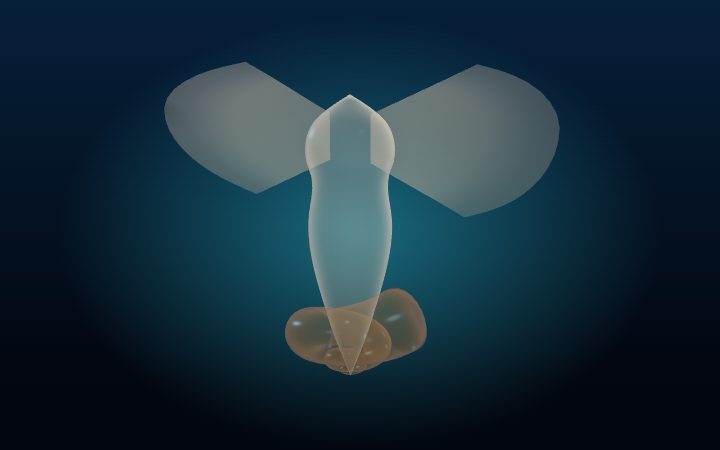
A translucent brown, left-coiling spiral shell about 1 cm across, with a pair of translucent wing-like fins above it that flutter like a butterfly's
More about this creature
Where and how deep it lives
It lives in Arctic and subarctic seas, especially the Arctic Ocean, where it is the only shelled pteropod. The Antarctic population turned out to be genetically very different (about a 34% difference in the COI gene) and is now treated as a separate species, Limacina antarctica; the two lineages are estimated to have evolved independently for around 31 million years.
Depth varies with size. Small individuals of 0.2–0.4 mm live mainly at 0–50 m, larger ones at 0–150 m, and adults have been recorded concentrated at 5–25 m at densities of up to 2.5 per cubic metre. In polar waters it can make up more than half of all zooplankton individuals.
Food and hunting
Its large, spherical mucus webs catch not only phytoplankton but also small zooplankton such as tintinnids and copepods, and even juveniles of its own species. Diatoms and dinoflagellates caught this way often pass through the gut largely intact.
Body and adaptations
The shell coils to the left in five or six whorls and is extremely thin, 5–10 mm wide (up to about 13 mm) and up to 6 mm tall. The wing-like parapodia are pale and translucent, while the soft body is dark purple.
It flaps its parapodia four to ten times a second at an angle of attack of about 45–50°, generating lift in a way similar to the clap-and-fling flight of tiny insects. With each half-stroke it also pitches its whole body back and forth by up to 60°, a 'hyper-pitching' motion not reported in other animals.
Life cycle and behaviour
It is a protandric hermaphrodite, maturing first as a male and later becoming female: individuals of 4–5 mm are male, and those over 5 mm turn female. Eggs are laid in ribbon-like clusters, mainly in summer; the veliger larva is about 0.15 mm long and reaches maturity at around 0.8 mm. It lives for about one to two years.
Herring, chum and pink salmon, rorqual whales, ringed and other seals, seabirds and large zooplankton all eat it. The sea angel Clione limacina feeds almost entirely on Limacina.
Humans and conservation
In 2014 NOAA researchers reported on a survey of the continental shelf from northern Washington to southern California carried out in August 2011: 53% of the pteropods sampled near the coast had severely dissolved shells. They estimated that the share of pteropods with dissolving shells nearshore had doubled since pre-industrial times and could triple by 2050, when coastal waters are projected to be 70% more corrosive than before industrialisation. The researchers said they had not expected damage on this scale in the region for several decades.
Lab work shows it can still lay down calcium carbonate at low aragonite saturation and tolerates higher CO2 than corals, but shell production is sensitive to falling pH. Its gene-expression response to acute stress suggests a limited capacity to acclimate to acidification and warming. Shelled pteropods are also a major carrier of carbon into the deep ocean.
Sources & further reading
- Limacina helicina — Wikipedia en.wikipedia.org
- Ocean acidity dissolving tiny snails' protective shell — NOAA Climate.gov www.climate.gov