Great white shark
Scientific name: Carcharodon carcharias
The Great white shark is a sea creature that lives in open water at depths of about 0–1,280 m, growing to about 6.4 m. In Abyss Dive you meet it at 115 m, in the Sunlight Zone (Epipelagic).
- Depth range
- about 0–1,280 m
- Max size
- about 6.4 m
- Zone in this guide
- Sunlight Zone 0–200 m
- Bioluminescence
- No
- Habitat
- Open water (swimming)
- Depth in the 3D dive
- 115 m
What is it?
The signature large predatory shark of temperate seas. It hunts seals and fish, and can detect smells and even the faint electrical signals given off by prey muscles.
Did you know?
Its teeth are replaced continuously, with new ones filling in where old ones fall out: thousands over a lifetime.
What it looks like
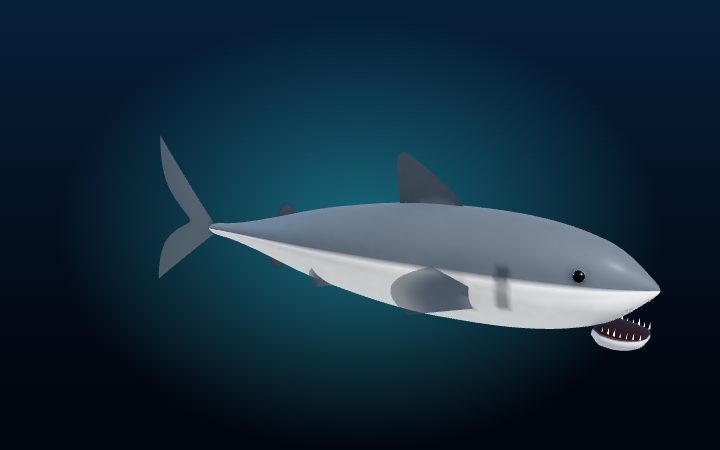
A stout, spindle-shaped body with a sharp line between the gray back and white belly, a conical snout, a large triangular dorsal fin, and a crescent tail with lobes of nearly equal size
More about this creature
Where and how deep it lives
Major populations live in the northwest and northeast Pacific, the western North Atlantic, the Mediterranean, southern Africa and Oceania, generally in water of 5–25 °C. Key coastal feeding sites include the Farallon Islands in California, Guadalupe Island in Mexico, Cape Cod in Massachusetts, South Africa's Western Cape, the Neptune Islands in Australia and Stewart Island in New Zealand.
Great whites also make long ocean crossings. Northeast Pacific sharks feed along the coast in autumn and winter, then gather offshore in spring and summer at the 'White Shark Café' between North America and Hawaii. One shark tagged in South Africa swam about 20,000 km to northwestern Australia and back in under nine months. They usually stay near the surface and dive deeper in the open ocean; some sources give a maximum depth of about 1,300 m, while others treat the 1,280 m record as an error.
Food and hunting
Young sharks eat mainly fish and cephalopods, and once they pass about 3 m they begin taking marine mammals such as seals, favouring newly weaned pups. Off California they ambush from below, seizing prey near the surface, while off South Africa they launch from about 20 m down to hit Cape fur seals, sometimes leaping about 3 m clear of the water. They also scavenge large whale carcasses.
Body and adaptations
It is countershaded, dark grey-blue above and white below. Its liver is so large, more than a quarter of its body weight, that the stored oil helps keep it buoyant. A network of blood vessels called the rete mirabile retains muscle heat; stomach temperatures of 24.7–26.8 °C have been measured in sharks swimming in 12.9–16.1 °C water. It cruises at about 3–5 km/h and can sprint at about 24 km/h, and because it breathes by forcing water over its gills, it must keep swimming.
Life cycle and behaviour
Eggs hatch inside the mother, and once the yolk is used up the embryos feed on uterine fluid and on unfertilised eggs the mother keeps producing. Gestation is thought to last about 12 months; litters of 2–10 pups (up to 14 in some sources) are born at 1–1.6 m, and at least two years pass before the next birth. A 2015 study found males mature at about 26 and females at about 33, and lifespan is estimated at more than 70 years.
Rank is generally set by size, and rivals competing for food may settle disputes by slapping water at each other with their tails. Their main predator is the orca: off South Africa, groups of two to six orcas have been seen flipping white sharks upside down to immobilise them and then eating their livers.
Humans and conservation
From 1580 to 2024, 351 unprovoked bites were recorded, 59 of them fatal, the most for any shark species, yet humans are generally not considered suitable prey. The 1975 film 'Jaws' cemented its man-eater image. Since 1955, almost every attempt to keep one in an aquarium has ended within days or weeks.
The IUCN Red List classes it as Vulnerable globally (2018 assessment) and Critically Endangered in Europe and the Mediterranean. Bycatch, recreational fishing and shark nets at swimming beaches are the main threats, and international trade is regulated under CITES Appendix II.
Sources & further reading
- Carcharodon carcharias — FishBase www.fishbase.se
- Great white shark — Wikipedia en.wikipedia.org