Pyrosome
Scientific name: Pyrosoma atlanticum
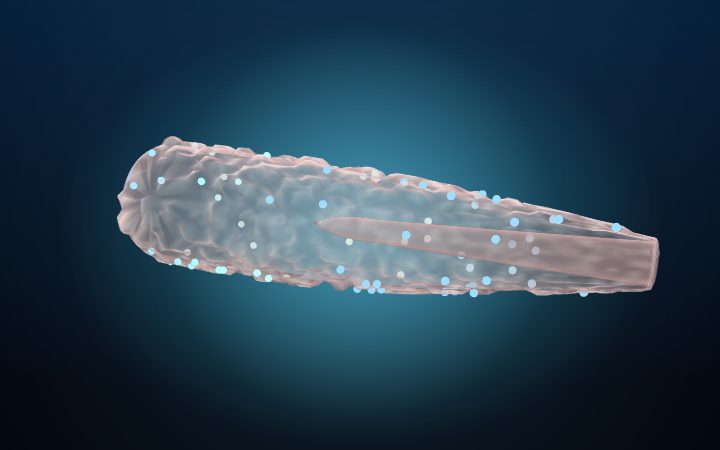
The Pyrosome is a bioluminescent (light-making) sea creature that lives in open water at depths of about 20–750 m, growing to about 60 cm. In Abyss Dive you meet it at 170 m, in the Sunlight Zone (Epipelagic).
- Depth range
- about 20–750 m
- Max size
- about 60 cm
- Zone in this guide
- Sunlight Zone 0–200 m
- Bioluminescence
- Yes
- Habitat
- Open water (swimming)
- Depth in the 3D dive
- 170 m
What is it?
A free-floating colony of thousands of tiny individuals arranged as a tube closed at one end, a kind of colonial sea squirt. Each day it travels up and down between tens of meters and more than 700 m.
Did you know?
The name means 'fire body' in Greek. Touch it and a wave of light spreads across the whole colony.
What it looks like
A translucent pink tube up to about 60 cm long, open at one end, with a bumpy surface of tiny projections (the individuals); light ripples along the tube in waves
More about this creature
Where and how deep it lives
Pyrosomes occur in every ocean except the Arctic, mostly in warm waters between about 50°N and 50°S. Some species are expanding their range as the ocean warms. How far they travel up and down each day varies widely.
Food and hunting
Each zooid in the colony draws water through a branchial basket and strains out microscopic plant cells and other particles. Pyrosomes rank among the most efficient filter feeders in the zooplankton, with a predator-to-prey mass ratio of almost 50 million to one.
Body and adaptations
Each zooid is usually a few millimetres long, bound to the others by a shared tunic. Colonies typically measure from about 2.5 cm to 60 cm, though some pyrosomes form giant colonies about 18 m long with an opening 2 m wide. The body is transparent, so each zooid's stomach, likened to a wire basket, is visible. Cilia in the branchial baskets generate a current that slowly jets the colony along; otherwise it drifts with the currents.
The light is a pale blue-green, visible from many tens of metres away. Each zooid has a pair of light organs thought to contain bioluminescent bacteria inside their cells, though the bacteria have not yet been identified. Zooids respond to light by producing light of their own, and this chain reaction sends waves of light rippling along the colony.
Life cycle and behaviour
Pyrosomes are hermaphrodites. A fertilised egg develops into an individual called a cyathozooid, which buds to form a first colony of four zooids. The two ends of the tube mature in opposite order, one producing sperm first and the other eggs first, so a colony can fertilise itself.
At least 62 open-water and 33 seafloor species are known to eat pyrosomes, and colonies offer shelter and a surface to settle on for other animals. About 35% of their dry weight is carbon, so sinking carcasses carry carbon down to the seafloor.
Humans and conservation
In 2017 pyrosomes appeared in unprecedented numbers along the Pacific coast of North America. In Alaska, fishers first noticed them in early February in densities high enough to clog gear, and they turned up for the first time in Gulf of Alaska bottom-trawl surveys running since 1984. Off Oregon, a five-minute research tow brought up about 60,000, and salmon trollers near Sitka, Alaska, quit fishing because pyrosomes were caught on almost every hook.
The cause is uncertain, but three years of unusually warm water beforehand are a leading suspect. Rockfish and sablefish were seen eating them, and scientists worried that they might compete with small plankton grazers that are better food for fish. There were also fears that a mass die-off could strip oxygen from coastal waters as the colonies decomposed, though this was never confirmed.
Sources & further reading
- Pyrosome — Wikipedia en.wikipedia.org
- Researchers Investigate Explosion in the Number of Pyrosomes off Alaska — NOAA Fisheries www.fisheries.noaa.gov
- Pyrosome 'fire body' bloom in the eastern Pacific — National Geographic (2017) www.nationalgeographic.com