Portuguese man o' war
Scientific name: Physalia physalis
The Portuguese man o' war is a sea creature that lives in open water at depths of about 0–10 m, growing to about 30 cm. In Abyss Dive you meet it at 2 m, in the Sunlight Zone (Epipelagic).
- Depth range
- about 0–10 m
- Max size
- about 30 cm
- Zone in this guide
- Sunlight Zone 0–200 m
- Bioluminescence
- No
- Habitat
- Open water (swimming)
- Depth in the 3D dive
- 2 m
What is it?
A siphonophore that drifts on the surface, pushed along by the wind. It looks like a jellyfish, but it isn't a single animal: it's a colony of specialized individuals (zooids). The gas-filled float rising above the water works as both a buoy and a sail.
Did you know?
Its stinging tentacles trail about 10 m below the surface, and sometimes more than 30 m.
What it looks like
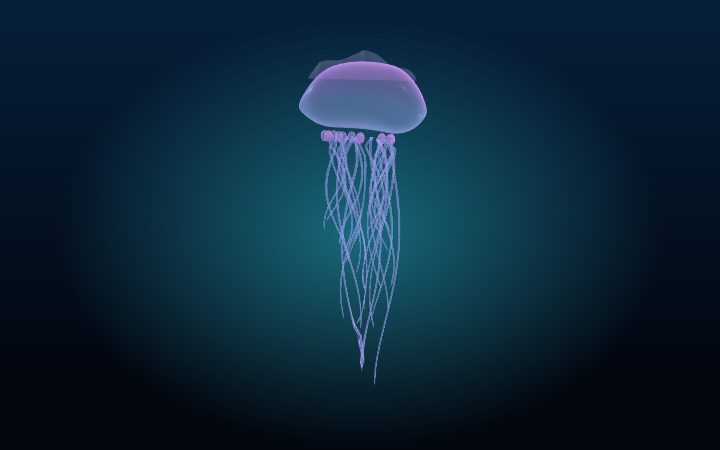
A translucent blue-to-purple balloon-shaped float about 30 cm long, with a crinkled sail-like crest on top; a bundle of long, thin blue tentacles hangs below
More about this creature
Where and how deep it lives
It turns up across the Atlantic, Indian and Pacific oceans, most often in tropical and subtropical seas. As a member of the neuston, the community living right at the sea surface, it has to cope with intense ultraviolet light, the risk of drying out and rough water. With no means of propulsion, it goes wherever wind, currents and tides push it, and strong onshore winds can sweep many into bays or onto beaches at once. Groups of more than 1,000 have been seen drifting together.
Food and hunting
The colony is a carnivore that takes small fish, molluscs, small crustaceans and zooplankton. Tentacle-bearing zooids wrap up prey and haul it in, and feeding zooids (gastrozooids) then envelop it and break it down with digestive enzymes. The nematocysts lining the tentacles fire venom on contact, paralysing and killing fish and molluscs. Catching and eating are handled by different members of the colony.
Body and adaptations
The float can exceed 30 cm in length, with a width of about 13 cm and a height of about 15 cm, and is tinted blue, violet or pink. It is filled mostly with air, but up to 13% of the gas is carbon monoxide that the animal produces itself. All zooids in a colony are genetically identical clones, and they come in seven forms: three medusoid and four polypoid types.
The sail on top of the float is either left- or right-handed. Left-handed colonies sail to the right of the wind and right-handed ones to the left; combined with the drag of the tentacles, this sets them moving at about 45° to the wind. As a result, a group caught by the same wind splits up, with the two forms heading off in different directions.
Life cycle and behaviour
Each colony is either male or female. Reproductive zooids release sperm or eggs straight into the water, but fertilisation and early development have never been observed in the wild. As a new colony develops, the float and a first zooid appear first, and the feeding and tentacle-bearing zooids are added later.
It has few known predators. Loggerhead turtles eat it regularly because the skin of their tongue and throat is too thick for the stings to penetrate, and the blue sea slug, a floating violet sea snail and the ocean sunfish also feed on it. The man-of-war fish lives among the tentacles, avoiding the stinging cells and nibbling on tentacles and reproductive zooids. Blanket octopuses, which are immune to the venom, carry broken-off tentacles to use for attack and defence.
Humans and conservation
A sting usually causes severe pain for one to three hours and leaves red, whip-like welts that last two or three days. In rare cases it can cause airway swelling, heart problems or shock, but deaths are extremely rare. In Australia the species is behind as many as 10,000 stings each summer. Immersion in 45 °C water for 20 minutes is recommended for pain, and a vinegar rinse is advised to stop further stinging cells from firing.
Stranded animals and detached tentacles can sting as painfully as live ones, and can still do so weeks after washing up, so beaches are sometimes closed. The common name comes from its resemblance to an 18th-century Portuguese warship under full sail, and the genus name Physalia comes from a Greek word meaning bubble or bladder.
Sources & further reading
- Portuguese man o' war — Wikipedia en.wikipedia.org
- What is a Portuguese man o' war? — NOAA Ocean Service oceanservice.noaa.gov