Giant oceanic manta ray
Scientific name: Mobula birostris
The Giant oceanic manta ray is a sea creature that lives in open water at depths of about 0–1,000 m, growing to about 7 m. In Abyss Dive you meet it at 42 m, in the Sunlight Zone (Epipelagic).
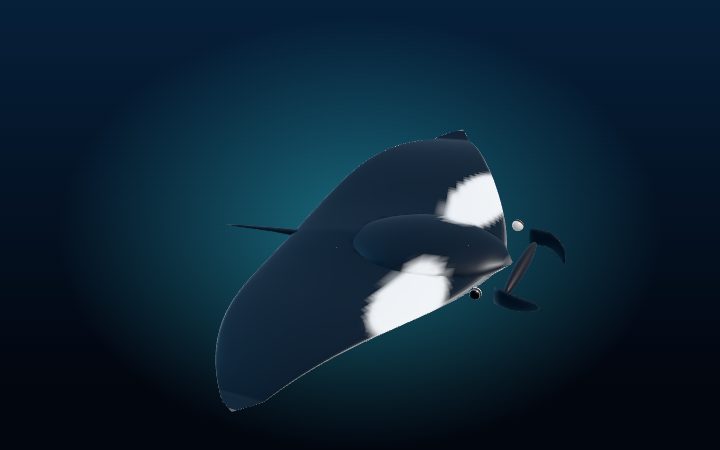
- Depth range
- about 0–1,000 m
- Max size
- about 7 m
- Zone in this guide
- Sunlight Zone 0–200 m
- Bioluminescence
- No
- Habitat
- Open water (swimming)
- Depth in the 3D dive
- 42 m
What is it?
The largest ray, with a wingspan usually up to about 7 m (some records say 9 m). It swims with its mouth wide open, filtering plankton. One has been recorded diving nearly 1,000 m.
Did you know?
Its brain is large for a fish of its size, and one study suggests mantas react to a mirror as if they recognize themselves.
What it looks like
A diamond-shaped, wing-like body more than twice as wide as it is long, a black back and white belly, two curled cephalic fins on either side at the front of the head, and a thin tail
More about this creature
Where and how deep it lives
Centred on tropical and subtropical seas worldwide, it also reaches temperate waters, with records as far north as southern California, New Jersey, Aomori Prefecture in Japan and the Azores, and as far south as Peru, Uruguay, South Africa and New Zealand. It spends most of its life far from land, following currents to plankton-rich upwelling zones and gathering around offshore islands. The lowest water temperature it has been recorded in is about 19 °C.
While feeding it often gathers in water shallower than 10 m, yet tagging shows dives of 200–450 m and some beyond 1,000 m. These dives appear to track prey whose position shifts with the seasons and the thermocline.
Food and hunting
Its staple is zooplankton such as euphausiids, copepods, mysids, decapod larvae and shrimp, and some studies report small fish as well. It herds prey into tight clusters and swims through them with its mouth open, unrolling the two cephalic fins in front of its head to funnel water and food inside. Tissue between the gill arches sieves out the particles, and up to 50 rays may gather at a rich feeding site.
A 2016 study estimated that about 73% of its diet comes not from surface waters but from deeper, mesopelagic sources. The familiar image of a manta filtering plankton at the surface may therefore show only part of what it eats.
Body and adaptations
The back is black, dark brown or steely blue and the belly white. Unlike the similar reef manta, it has sharply defined white shoulder markings forming a 'T', dark spots clustered on the lower belly, and often a black mouth interior and gill-slit area. Markings differ between individuals, so rays can be identified from photographs.
Its brain, up to about 200 g, is the largest of any fish, and a network of blood vessels called the rete mirabile warms the blood flowing to it. Teeth occur in 18 rows confined to the centre of the lower jaw. It must keep swimming to push water over its gills, so it cannot rest on the seabed.
Life cycle and behaviour
Normally solitary, it visits reef 'cleaning stations', holding still while cleaner fish pick off parasites and loose skin, with visits peaking at high tide. When a female is ready to mate, several males may follow her in a 'train', and a male grips her pectoral fin in his teeth during a mating that lasts a few minutes.
Males mature at a disc width of about 4 m and females at about 5 m. Eggs hatch inside the mother, and with no placenta the pup feeds on uterine secretions. Gestation lasts about a year, and usually a single pup (occasionally two) is born at a disc width of about 1.2–1.4 m. Females give birth only every two to three years, among the lowest reproductive rates of any shark or ray.
Humans and conservation
The IUCN Red List classes it as Endangered (assessed 2019), and the US listed it as threatened under the Endangered Species Act in 2018. Targeted fishing and bycatch are the main threats. Since the 1970s, demand for its gill plates as a traditional Chinese medicine has grown, with prices of up to US$400 per kilogram, though there is little evidence the remedy works. International trade has been regulated under CITES Appendix II since 2014; Ecuador may host more than 22,000 animals, but most other regional populations are estimated at only about 600–2,000.
Sources & further reading
- Mobula birostris — FishBase www.fishbase.se
- Giant oceanic manta ray — Wikipedia en.wikipedia.org
- Giant Manta Ray — NOAA Fisheries www.fisheries.noaa.gov