Whale shark
Scientific name: Rhincodon typus
The Whale shark is a sea creature that lives in open water at depths of about 0–1,930 m, growing to about 12 m. In Abyss Dive you meet it at 60 m, in the Sunlight Zone (Epipelagic).
- Depth range
- about 0–1,930 m
- Max size
- about 12 m
- Zone in this guide
- Sunlight Zone 0–200 m
- Bioluminescence
- No
- Habitat
- Open water (swimming)
- Depth in the 3D dive
- 60 m
What is it?
A shark well over 10 m long, yet a gentle filter feeder that strains plankton and small fish from the water. The white spots on its back are unique to each individual, like fingerprints.
Did you know?
The largest living fish. It has been recorded diving to about 1,900 m.
What it looks like
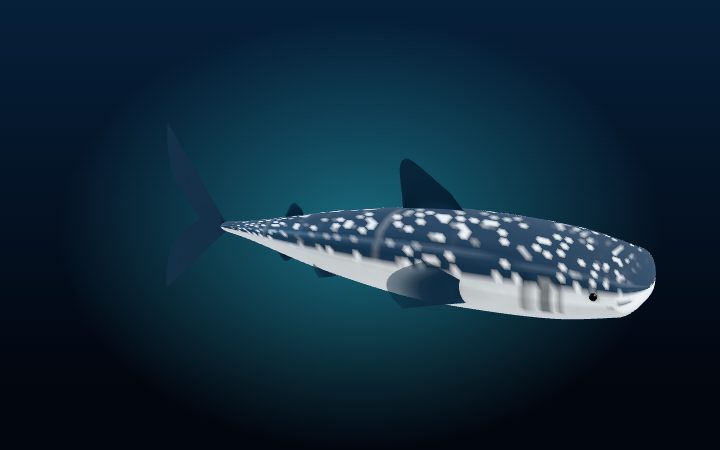
A broad, flat head with a wide, straight mouth at the very front, a dark blue-gray back with a grid of white spots and pale stripes, three ridges along each flank, and a crescent tail
More about this creature
Where and how deep it lives
It lives in all tropical and warm-temperate seas except the Mediterranean, usually between 30°N and 35°S in water warmer than 21 °C. There are two subpopulations, Atlantic and Indo-Pacific, with about 75% of all whale sharks in the Indo-Pacific. They gather in the same seasons each year at sites such as Ningaloo Reef in Western Australia, Mexico's Yucatán Peninsula, Mafia Island in Tanzania, Mozambique, the Philippines and the Maldives; in 2009 more than 400 gathered off the Yucatán.
About 95% of its time is spent shallower than 200 m, yet it regularly dives beyond 500 m, and some individuals have stayed below 50 m for three days or more. A pregnant female nicknamed 'Rio Lady' travelled 7,772 km in 150 days and dived to about 1,600 m along the way.
Food and hunting
It eats copepods, krill, arrow worms, jellyfish, fish eggs, crab larvae, small fish such as sardines, anchovies, mackerel and young tuna, and squid. It also targets the clouds of eggs released during mass spawning by fish and corals.
It feeds both by ram filtration, swimming forward with its mouth open, and by active suction, pumping water in through its gills while nearly stationary. Twenty filter pads in its mouth use cross-flow filtration, letting water sweep across rather than straight through, which reduces clogging, and it can process more than 6,000 litres of water an hour. It has over 300 rows of tiny teeth, but they play no part in feeding.
Body and adaptations
The largest on record is an 18.8 m female reported from the Arabian Sea in 2001. A study at Ningaloo Reef estimated that adult females average about 14.5 m and males 8–9 m, so females grow much larger. Its skin can be up to 15 cm thick, and its eyeballs are covered with specialised denticles that differ from those on the body and protect the eyes. Wounds heal well, and the spot pattern can even re-form over an injury.
Life cycle and behaviour
It is ovoviviparous: eggs hatch inside the mother, who gives birth to live young. A 10.6 m female caught in July 1996 carried about 300 embryos, and pups are born at 40–60 cm. Mating was filmed for the first time at Ningaloo Reef in 2019.
Maturity comes late, with males maturing at 8–9 m and around 25 years of age. A 2020 radiocarbon study confirmed that one growth band forms in the vertebrae each year, leading to an age estimate of about 50 years for a 10 m female. Lifespan is thought to be around 80–130 years.
Humans and conservation
Science first learned of it from a 4.6 m specimen harpooned in Table Bay, South Africa, in April 1828, which Andrew Smith described the following year. The IUCN Red List classes it as Endangered (assessed 2025); the global population has fallen by about 50% over 75 years, and by about 63% in the Indo-Pacific.
The main threats are fisheries bycatch, ship strikes and pollution; in 2006, 65% of the sharks surveyed in Djibouti's Arta Bay bore propeller injuries. It was listed on CITES Appendix II in 2003, and the Philippines (1998), India (2001) and Taiwan (2007) banned commercial fishing for it. Today it is highly valued for ecotourism, and in the Philippines snorkellers must keep at least 1.2 m away.
Sources & further reading
- Rhincodon typus — FishBase www.fishbase.se
- Whale shark — Wikipedia en.wikipedia.org