Megamouth shark
Scientific name: Megachasma pelagios
The Megamouth shark is a sea creature that lives in open water at depths of about 5–1,000 m, growing to about 7 m. In Abyss Dive you meet it at 140 m, in the Sunlight Zone (Epipelagic).
- Depth range
- about 5–1,000 m
- Max size
- about 7 m
- Zone in this guide
- Sunlight Zone 0–200 m
- Bioluminescence
- No
- Habitat
- Open water (swimming)
- Depth in the 3D dive
- 140 m
What is it?
A large filter-feeding shark that was only formally reported to science in 1983. It strains small shrimp such as krill, along with jellyfish, through its huge mouth. It's thought to stay below about 100 m by day and rise to shallower water at night.
Did you know?
A bright white band runs along the snout just above the upper jaw. It may play a role in feeding or in recognizing one another, though that's only a guess.
What it looks like
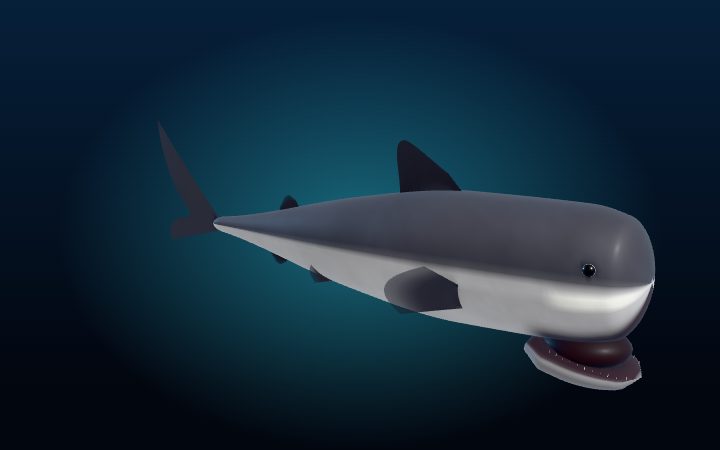
A blunt, rounded big head with a wide mouth taking up most of the front of the body, a white band above the upper jaw, a soft, dark gray-brown body, and a long upper tail lobe
More about this creature
Where and how deep it lives
It has been recorded in the Pacific, Atlantic and Indian oceans, from places including Hawaii, California, Mexico, Australia, Brazil, South Africa and Ecuador. As of March 2025, 296 had been caught or sighted, and Japan, the Philippines and Taiwan have each logged more than ten, together accounting for over half the world total. Some records place it as deep as about 1,500 m.
It changes depth on a daily cycle. A 4.9 m male tagged off Dana Point, California, in 1990 stayed at about 120–160 m by day and rose to 12–25 m at night, and a 2024 study in Taiwan found an even wider swing, from about 400–700 m by day to 0–50 m at night. The pattern is thought to follow the vertical migration of its plankton prey.
Food and hunting
Swimming with its mouth wide open, it filters out zooplankton such as krill, copepods, jellyfish and the larvae of shrimp and crabs, and it may also take small midwater fish.
Body and adaptations
Males average about 4 m and females about 5 m, with a reported maximum weight of 1,215 kg; a 2024 study suggested one male from Ecuador may have reached 8–9 m. The mouth can be up to 1.3 m wide, with up to 50 rows of small, peg-like teeth in the upper jaw and up to 75 in the lower.
Its body is soft and flabby and lacks keels on the tail, making it a relatively poor swimmer, probably less active than whale or basking sharks. Electrosensory pores are concentrated on its head, though it has fewer of them than any other known shark. Early researchers thought the white band on its lip might glow, but a 2020 study concluded that it produces no light and is simply highly reflective.
Life cycle and behaviour
It is ovoviviparous: the eggs hatch inside the mother, and once their yolk is gone the embryos feed on other eggs she produces. Pups are born at less than 177 cm, and males mature at about 4 m. Genetic analysis found no differences between regions, suggesting a single, wide-ranging interbreeding population.
In September 2022, two megamouths were filmed together for the first time, with the male trailing the female in what may have been courtship. The cookiecutter shark, which gouges round wounds in its skin, is a known predator.
Humans and conservation
The first specimen was hauled up on 15 November 1976, northeast of Kahuku, Hawaii, after it became tangled in a sea anchor deployed by a US Navy research vessel at about 165 m. In 1983 Taylor, Compagno and Struhsaker described it as a new species in a family of its own, Megachasmidae. Fossils trace the lineage back about 36 million years. The IUCN Red List classes it as Least Concern, and it is of no interest to fisheries.
Sources & further reading
- Megachasma pelagios — FishBase www.fishbase.se
- Megamouth shark — Wikipedia en.wikipedia.org