Moon jellyfish
Scientific name: Aurelia aurita
The Moon jellyfish is a sea creature that lives in open water at depths of about 0–200 m, growing to about 40 cm. In Abyss Dive you meet it at 12 m, in the Sunlight Zone (Epipelagic).
- Depth range
- about 0–200 m
- Max size
- about 40 cm
- Zone in this guide
- Sunlight Zone 0–200 m
- Bioluminescence
- No
- Habitat
- Open water (swimming)
- Depth in the 3D dive
- 12 m
What is it?
A jellyfish with a translucent bell through which four clover-shaped gonads show. It's common along coasts, and can bloom in huge numbers when the water warms.
Did you know?
It's mostly water, with no brain and no heart; a simple nerve net is all it uses to move.
What it looks like
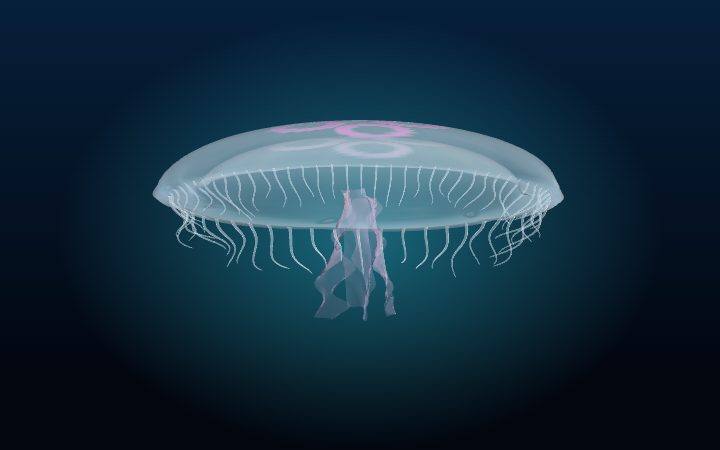
A flat, translucent, disc-shaped bell with four purple-to-pink horseshoe-shaped gonads in the center, hundreds of short, fine tentacles around the edge, and four short oral arms
More about this creature
Where and how deep it lives
Aurelia aurita in the strict sense is native to the northeastern Atlantic, and its type specimen came from the Baltic Sea. Introduced populations have become established in the northeastern United States and Argentina. It was long treated as a single worldwide species, but work in the 2020s split it into at least 28 species, so many 'moon jellies' elsewhere may belong to other species.
Moon jellies of the genus Aurelia live mainly in temperate coastal waters, estuaries and harbours. They tolerate roughly 6–31 °C, do best at 9–19 °C, and cope with salinity as low as 6 ppt. They are often most abundant where oxygen near the bottom falls below 2.0 mg per litre, because they handle low oxygen better than the fish they compete with.
Food and hunting
Zooplankton is the staple, including copepods, small molluscs and fish eggs, and occasionally other jellyfish and comb jellies. Prey is caught by stinging cells on the short, fine tentacles around the bell, bound up in mucus, and carried by beating cilia into the gut cavity. In Japan's Seto Inland Sea, gatherings of moon jellies were estimated to eat essentially all of the mid-sized zooplankton during July and August.
Body and adaptations
The adult bell is about 25–40 cm across, fringed with hundreds of short tentacles. There are no dedicated respiratory, excretory or circulatory organs: oxygen diffuses in through the body surface, and cilia keep water moving through the gut cavity. Sense organs called rhopalia around the rim detect light, darkness and orientation. Because the body is transparent, the gut changes colour depending on what it has eaten.
Life cycle and behaviour
The life cycle alternates between a drifting medusa and a polyp fixed to the seabed. Medusae are male or female; males release sperm, which females take in, and the resulting planula larvae, under 1 mm long, settle on the bottom and become polyps (scyphistomae). A polyp can survive months without food, and mainly in response to seasonal temperature changes it strobilates, slicing itself crosswise to release ephyrae about 1 cm across.
Studies show that polyps lacking their native microbes produce few or malformed ephyrae. Wild medusae rarely live much beyond six months, though aquarium animals often survive for years, and a 2015 study found they can reverse their life cycle and revert to earlier stages. Ocean sunfish, leatherback turtles, other jellyfish and seabirds all eat them.
Humans and conservation
The sting is so mild that most people feel little or nothing. Large swarms, however, can clog and damage fishing nets, forcing fishers to move elsewhere. A 2020 study found that moon jellies recognised plastic microbeads as non-food and showed no detectable physiological harm from them.
Sources & further reading
- Aurelia aurita — Wikipedia en.wikipedia.org
- Aurelia (cnidarian) — Wikipedia en.wikipedia.org