Comb jelly
Scientific name: Beroe forskalii
The Comb jelly is a sea creature that lives in open water at depths of about 0–630 m, growing to about 20 cm. In Abyss Dive you meet it at 150 m, in the Sunlight Zone (Epipelagic).
- Depth range
- about 0–630 m
- Max size
- about 20 cm
- Zone in this guide
- Sunlight Zone 0–200 m
- Bioluminescence
- No
- Habitat
- Open water (swimming)
- Depth in the 3D dive
- 150 m
What is it?
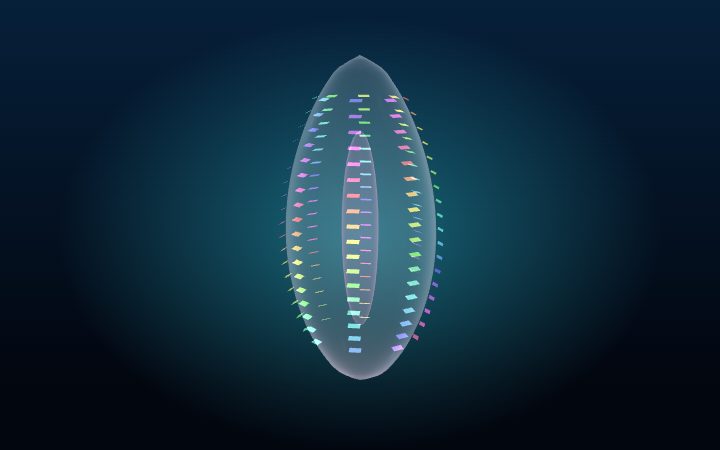
It looks like a jellyfish but belongs to a completely different group, the ctenophores. It swims by beating eight rows of comb-like cilia along its body, and it swallows other comb jellies whole.
Did you know?
The rainbow shimmer rippling along the comb rows isn't light the animal makes. It's the cilia scattering light.
What it looks like
A flattened, thimble- or sac-shaped transparent body, wide open at the front (no tentacles), with eight vertical comb rows shimmering in rainbow colors and pinkish branches of the gut
More about this creature
Where and how deep it lives
It has been recorded in the Atlantic, the Mediterranean, the Pacific and Antarctic waters, from the tropics to polar seas. It drifts at depths of 0–630 m and is reported mainly over the outer continental shelf and slope. In 2014 it was recorded for the first time off the Atlantic coast of South America.
Food and hunting
Unlike most comb jellies, which eat zooplankton, members of the genus Beroe prey mainly on other comb jellies. This species swims rapidly in a spiral and engulfs its prey whole. Its mouth is lined with macrocilia, each capped with pointed teeth that switch from a straight to a hooked shape during the beat, which is thought to help it swallow and break up prey. The size and arrangement of the macrocilia differ between species and help in identifying them.
Body and adaptations
It belongs to the Nuda, the only comb jellies with no tentacles or tentacle sheaths at all, and a large mouth takes up most of its body. Each comb plate is made of thousands of cilia up to about 2 mm long, and the animal usually travels mouth first. It grows to a maximum length of about 20 cm.
Beroe species are bioluminescent. In comb jellies, light is generally produced by calcium-activated photoproteins in cells along the canals beneath the comb rows. They have a nerve net but no brain or central nervous system, and they can regenerate damaged tissue.
Life cycle and behaviour
Comb jellies are generally hermaphrodites, and most are presumed capable of self-fertilisation. Nearly all other comb jellies pass through a tentacled, cydippid-like juvenile stage, but young Beroe lack tentacles from the start and already have large mouths.
Humans and conservation
It has not been assessed by the IUCN and is not fished. A relative, Beroe ovata, helped bring under control the invasive comb jelly Mnemiopsis leidyi, which had disrupted the Black Sea ecosystem, by eating it. Comb jelly nervous systems have the smallest known genetic toolkit of any animal's, which makes them useful for studying the minimum requirements for a working nervous system.
Sources & further reading
- Beroe forskalii — SeaLifeBase www.sealifebase.se
- Ctenophora — Wikipedia en.wikipedia.org
- Beroe (ctenophore) — Wikipedia en.wikipedia.org