Opah (Moonfish)
Scientific name: Lampris guttatus
The Opah (Moonfish) is a sea creature that lives in open water at depths of about 0–310 m, growing to about 1 m. In Abyss Dive you meet it at 220 m, in the Twilight Zone (Mesopelagic).
- Depth range
- about 0–310 m
- Max size
- about 1 m
- Zone in this guide
- Twilight Zone 200–1,000 m
- Bioluminescence
- No
- Habitat
- Open water (swimming)
- Depth in the 3D dive
- 220 m
What is it?
A round, flat fish about the size of a car tire, dotted with white spots. It flaps its red pectoral fins like a bird's wings to swim, hunting squid and fish in cold, dark water tens to hundreds of meters down.
Did you know?
A 2015 NOAA study revealed the first known 'whole-body warm' fish. Flapping its fins generates heat, and heat-exchange structures in the gills hold it in, keeping its muscles about 5°C warmer than the surrounding water.
What it looks like
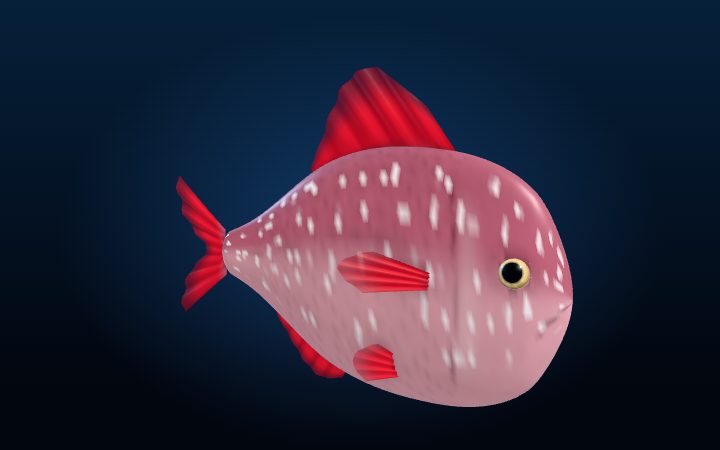
A nearly round, flat, silvery-pink body with white spots (seen from the side), crimson fins throughout (a tall sickle-shaped dorsal fin and long pectoral fins), big eyes, and a small mouth
More about this creature
Where and how deep it lives
Opahs live in temperate and tropical oceans worldwide. A 2018 taxonomic review split the former Lampris guttatus into several species; L. guttatus in the strict sense lives in the North Atlantic, including the Mediterranean, while the North Pacific population is now treated as a separate species, L. incognitus.
They live mainly at depths of 50–500 m and prefer water warmer than 7 °C. In the North Pacific they migrate daily between about 100–400 m by day and 50–100 m at night, and satellite tracking shows them spending most of their time at about 45–400 m and rarely coming to the surface.
Food and hunting
Squid, krill and small fish make up most of the diet. NOAA researchers describe the opah not as a sluggish drifter but as an active predator that chases down agile squid.
Body and adaptations
The body is a tall, laterally compressed disc, reddish-orange with scattered white spots, vermilion fins and golden rings around the eyes. The scales are minute, and the silvery guanine coating rubs off easily. L. guttatus in the strict sense reaches about 2 m and 86 kg, with reports of up to 270 kg.
Body heat comes mainly from the pectoral fin muscles, parts of which generate heat without contracting. Fat around the gills, heart and muscles acts as insulation, and a second heat-exchanging network of blood vessels in the head keeps the brain and eyes about 2 °C warmer than the rest of the body. It is not a true homeotherm like birds and mammals, though, so its body temperature still shifts with the surrounding water.
Life cycle and behaviour
Opahs are apparently solitary and probably spawn in spring. The larvae start out long and slender like ribbonfish larvae and then rapidly deepen into the adult shape; in L. guttatus this is complete at about 10.6 mm. Tagging studies point to large sharks such as great whites and makos as their main predators.
Humans and conservation
Whole-body warmth was reported in 2015 in the journal Science by Nicholas Wegner's team at NOAA's Southwest Fisheries Science Center. The discovery began when a gill sample collected by colleague Owyn Snodgrass revealed a structure never before seen in a fish's gills. Opahs are taken as bycatch in tuna fisheries and elsewhere, and their rich meat is sold fresh, frozen and as sashimi, growing in popularity in seafood markets. The IUCN Red List classes it as Least Concern (assessed 2013).
Sources & further reading
- Warm Blood Makes Opah an Agile Predator — NOAA Fisheries www.fisheries.noaa.gov
- Lampris guttatus — FishBase www.fishbase.se
- Opah — Wikipedia en.wikipedia.org