Barreleye
Scientific name: Macropinna microstoma
The Barreleye is a sea creature that lives in open water at depths of about 16–1,270 m, growing to about 15 cm. In Abyss Dive you meet it at 680 m, in the Twilight Zone (Mesopelagic).
- Depth range
- about 16–1,270 m
- Max size
- about 15 cm
- Zone in this guide
- Twilight Zone 200–1,000 m
- Bioluminescence
- No
- Habitat
- Open water (swimming)
- Depth in the 3D dive
- 680 m
What is it?
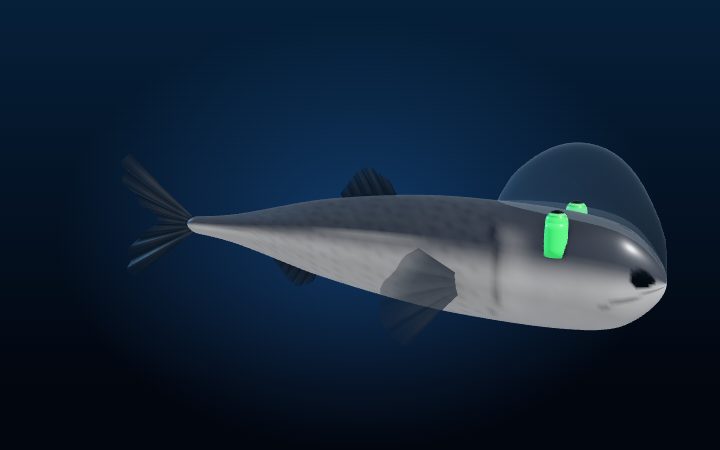
Its head is topped by a transparent dome with a pair of green, tubular eyes inside. The two spots above its mouth aren't eyes but nostrils. It lives alone, mostly in the lower part of the mesopelagic.
Did you know?
That its tubular eyes can swing from pointing up to pointing forward inside the transparent head was only confirmed in the late 2000s, by observing living animals.
What it looks like
A dark brown body, green tubular eyes pointing upward inside a transparent dome over the head, two small nostrils above the mouth, and broad, horizontal pectoral fins
More about this creature
Where and how deep it lives
The barreleye ranges across the North Pacific from the Bering Sea to Japan and Baja California, living in the deep middle waters beneath temperate and subarctic seas. Records span about 16–1,267 m, and the fish MBARI observed off central California hung at about 600–800 m. Midwater trawls catch it over seafloor 1,600–3,600 m deep.
It is rarely seen: in more than 5,600 dives and over 27,600 hours of video, MBARI's ROVs have encountered it only nine times.
Food and hunting
Its small, pointed mouth suits picking off small prey one at a time, while its very large digestive system suggests it can eat plenty of small drifting animals and jellies. The stomachs of two net-caught fish held jelly fragments, and FishBase suggests a mixed diet of gelatinous and crustacean zooplankton, including siphonophore tentacles.
MBARI researchers speculate that it moves among the tentacles of Apolemia siphonophores, colonial jellies that can exceed 10 m, stealing copepods and other prey the tentacles have caught. The transparent shield could protect its eyes from the jellies' stinging cells as it does so.
Body and adaptations
It grows to about 15 cm. The transparent shield over its head is filled with fluid; nets tend to destroy it, which is why older illustrations left it out. The tubular eyes have bright green lenses, and one hypothesis is that the pigment filters direct sunlight from above, helping the fish pick out the bioluminescent glow of animals overhead.
Large, flat fins let it hang almost motionless in a horizontal position and make precise turns. It normally waits with its eyes pointing up, then rotates them forward and swims upward when it spots prey.
Life cycle and behaviour
It lays eggs and its larvae drift in the plankton, but little else is known about its reproduction. Barreleyes are presumed to be solitary, staying just below the depth where light fades out and not making daily vertical migrations.
Humans and conservation
The species was described in 1939, but for decades its eyes were thought to be fixed, giving only a narrow view straight up. MBARI's Bruce Robison and Kim Reisenbichler kept a net-caught fish alive for several hours in a shipboard aquarium, watched its eyes rotate as it turned from horizontal to vertical, and published the finding in Copeia in 2008. It has no commercial value, turns up occasionally as bycatch, and has not yet been assessed by the IUCN.