Giant squid
Scientific name: Architeuthis dux
The Giant squid is a sea creature that lives in open water at depths of about 300–1,000 m, growing to about 12 m. In Abyss Dive you meet it at 750 m, in the Twilight Zone (Mesopelagic).
- Depth range
- about 300–1,000 m
- Max size
- about 12 m
- Zone in this guide
- Twilight Zone 200–1,000 m
- Bioluminescence
- No
- Habitat
- Open water (swimming)
- Depth in the 3D dive
- 750 m
What is it?
A giant squid about 12 m long including its tentacles. Long taken for a legendary monster (the kraken), it was first filmed alive in the deep sea in 2004 by Japanese researchers.
Did you know?
Its eyes can be up to about 27 cm across, among the largest in the animal kingdom.
What it looks like
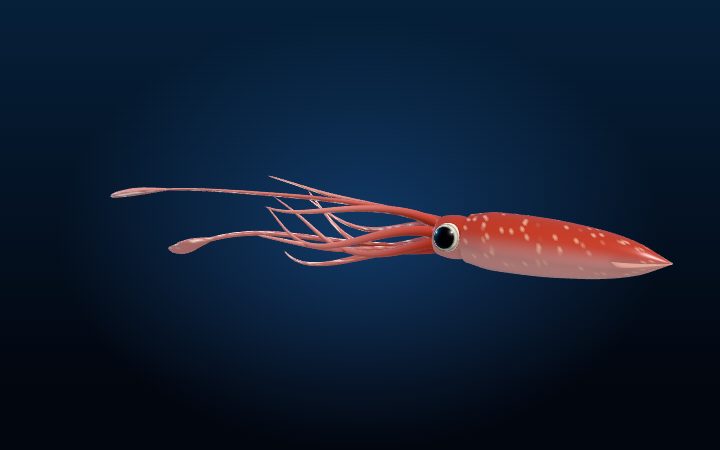
An elongated red mantle with small terminal fins, two tentacles longer than the body (clubs tipped with suckers), eight arms, and enormous eyes
More about this creature
Where and how deep it lives
Giant squid occur in every ocean, especially near continental and island slopes, and are rare in tropical and polar waters. Trawled specimens and the diving depths of sperm whales, which eat them, suggest they live at about 300–1,000 m. A 2013 University of Copenhagen study found that mitochondrial DNA from specimens worldwide differed at only 181 of 20,331 base pairs, and concluded there is a single global species.
Food and hunting
They eat deep-sea fish such as orange roughy and other squid, and appear to hunt alone. The two long tentacles seize the prey, which is then torn apart with the beak and the tongue-like radula. The suckers are about 2–5 cm across and ringed with serrated chitin.
In June 2019, about 160 km (100 miles) southeast of New Orleans in the Gulf of Mexico, a juvenile roughly 3–3.7 m long was filmed by the Medusa, a camera that uses red light most deep-sea animals can't see, paired with an electronic jellyfish lure. The squid actively tracked and attacked the lure, challenging the idea that it simply waits for prey to drift past.
Body and adaptations
The mantle is about 2 m long; none of 130 specimens examined exceeded 2.25 m. From fins to arm tips, females reach about 5 m and males slightly less. The feeding tentacles, usually held out of sight, extend to about 10 m, and claims of 20 m or more are undocumented. Maximum weight is estimated at about 275 kg for females and 150 kg for males.
Instead of a swim bladder, it stays near neutral buoyancy with an ammonium chloride solution stored in its tissues. It has two large gills and a closed circulatory system, and its age can be estimated from growth rings in the statoliths, the balance stones in its statocysts.
Life cycle and behaviour
Giant squid appear to mature at about three years, with males maturing at a smaller size than females. A female can carry more than 5 kg of eggs, each only about 0.5–1.4 mm long. Males have a penis over 90 cm long, and one hypothesis is that sperm packets are injected into the female's arms, though how fertilization works is still debated.
Predators of adults include sperm whales, pilot whales, southern sleeper sharks and, in some regions, killer whales. Beak fragments of other giant squid found in specimens from Tasmania suggest occasional cannibalism.
Humans and conservation
Japetus Steenstrup described the genus Architeuthis in 1857. Strandings were unusually frequent in Newfoundland and New Zealand in the late 19th century, and researcher Frederick Aldrich even proposed that they come in roughly 90-year cycles.
Sightings remained rare after the first wild photographs of 2004. In July 2012 a squid about 3 m long was filmed feeding for some 23 minutes in Japan's Ogasawara Islands, and in December 2015 a 3.7 m juvenile that entered Toyama harbor was guided back to open water. The 2019 Gulf of Mexico footage was the first of a live giant squid in US waters.
Sources & further reading
- Giant squid — Wikipedia en.wikipedia.org
- How scientists got that amazing giant squid video — National Geographic (2019) www.nationalgeographic.com