Spotted lanternfish
Scientific name: Myctophum punctatum
The Spotted lanternfish is a bioluminescent (light-making) sea creature that lives in open water at depths of about 0–1,000 m, growing to about 11 cm. In Abyss Dive you meet it at 330 m, in the Twilight Zone (Mesopelagic).
- Depth range
- about 0–1,000 m
- Max size
- about 11 cm
- Zone in this guide
- Twilight Zone 200–1,000 m
- Bioluminescence
- Yes
- Habitat
- Open water (swimming)
- Depth in the 3D dive
- 330 m
What is it?
A small fish that makes light with rows of photophores along its sides and belly. By day it stays at about 225–750 m, and at night it rises toward the surface to feed.
Did you know?
Lanternfish are among the most common deep-sea fish, and their nightly vertical migration is considered the largest animal migration on Earth.
What it looks like
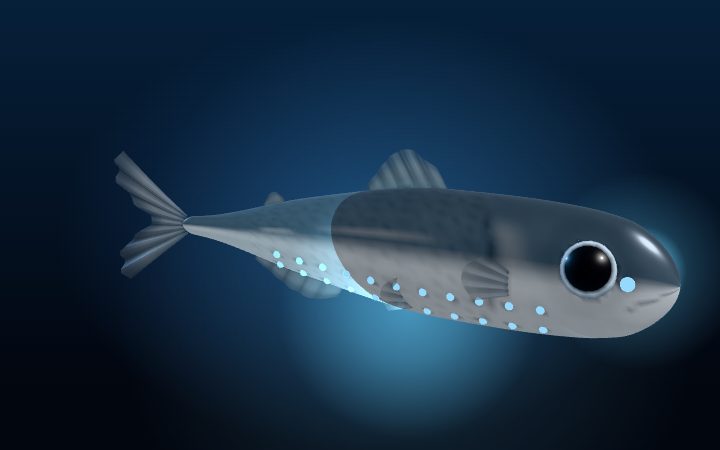
A slender fish about 10 cm long with very large eyes for its size, rows of small blue light organs on the belly and flanks, and a forked tail
More about this creature
Where and how deep it lives
It lives in the North Atlantic and the Mediterranean. In the western Atlantic it ranges from Greenland to the US coast, and in the east south to the Mauritanian upwelling region (15–20°N), with scattered records near 30°N. It has been reported as one of the dominant species in midwater fish communities around the Mid-Atlantic Ridge. At night it rises into the top 125 m or so to feed.
Food and hunting
It feeds mostly on copepods and euphausiids (krill), along with crab zoea larvae and fish fry.
Body and adaptations
It grows to about 11 cm standard length and matures at around 5 cm. Its larvae have eyes on stalks. Across the lanternfish family, photophore patterns are species-specific and are thought to help with recognition, shoaling and courtship, and in some species the luminous patches near the tail differ between males and females. Photophores on the belly are adjusted to match the light filtering down from above, hiding the fish's silhouette from predators below.
Life cycle and behaviour
It rises towards the surface at dusk and descends again before daybreak. In lanternfish, this migration is interpreted as a way to avoid predators while following plankton prey that migrate on the same schedule, and the pattern varies with species, life stage, sex, latitude and season. Little published information exists on this species' spawning season or lifespan.
Humans and conservation
During the Second World War, sonar operators detected a 'false sea floor' 300–500 m down during the day. It turned out to be millions of small midwater fish with gas-filled swim bladders, many of them lanternfish, and this deep scattering layer sinks deeper when the moon is out and rises under cloud. Lanternfish are estimated to make up as much as 65% of deep-sea fish biomass and feed many predators, including whales, dolphins, salmon, tuna, penguins and Humboldt squid.
By releasing faecal pellets at depth, they make the biological pump that carries carbon into the deep sea more efficient. One lanternfish caught near the eastern Pacific garbage patch had more than 80 plastic fragments in its gut. This species is listed as Least Concern on the IUCN Red List.
Sources & further reading
- Myctophum punctatum — FishBase www.fishbase.se
- Lanternfish — Wikipedia en.wikipedia.org
- Myctophum punctatum — Wikipedia en.wikipedia.org