Swordfish
Scientific name: Xiphias gladius
The Swordfish is a sea creature that lives in open water at depths of about 0–2,878 m, growing to about 4.5 m. In Abyss Dive you meet it at 420 m, in the Twilight Zone (Mesopelagic).
- Depth range
- about 0–2,878 m
- Max size
- about 4.5 m
- Zone in this guide
- Twilight Zone 200–1,000 m
- Bioluminescence
- No
- Habitat
- Open water (swimming)
- Depth in the 3D dive
- 420 m
What is it?
A large predatory fish whose upper jaw stretches into a long, flat blade. It lives mostly between the surface and 550 m, but has been recorded as deep as about 2,900 m. It slashes at prey with its bill to stun it.
Did you know?
Special heater tissue near the eyes keeps the eyes and brain 10–15°C warmer than the surrounding water, so it keeps its sight even in cold, deep water.
What it looks like
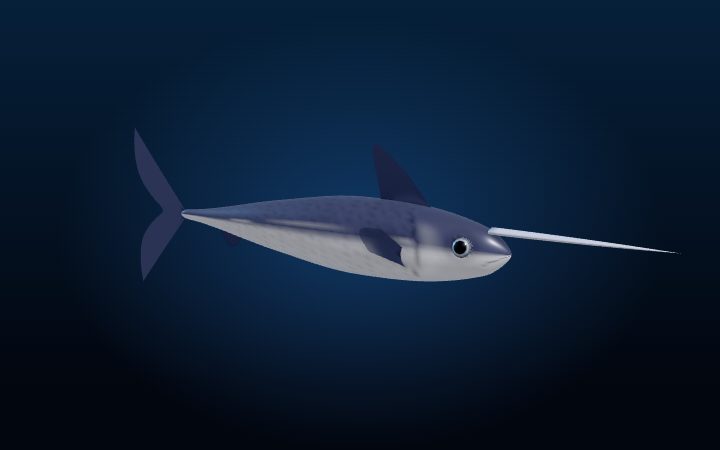
A flat, sword-shaped upper jaw about a third of the body length, a scaleless, dark purple-gray spindle-shaped body, a tall sickle-shaped dorsal fin, and a large crescent tail
More about this creature
Where and how deep it lives
Swordfish range across tropical and temperate parts of the Atlantic, Indian and Pacific oceans, including the Mediterranean and Black seas, and sometimes turn up in cold water. They tolerate about 5–27 °C, the widest range of any billfish, but prefer water of about 18–22 °C.
By day they tend to stay deep, near the deep scattering layer where swarms of small animals reflect sonar; at night they rise toward the surface to feed. They also migrate seasonally, heading toward cooler water to feed in summer and back to warmer water in autumn. The North Atlantic population travels thousands of kilometers each year along the eastern seaboard of the US and Canada.
Food and hunting
Adults eat open-water fish such as mackerel, herring, silver hake and lanternfishes, along with bottom-dwelling fish, squid and crustaceans. In a stomach survey of 168 swordfish from the northwest Atlantic, 82% had eaten squid and 53% had eaten fish.
Despite the popular image, the bill is mainly swung sideways to injure prey rather than used to skewer it. Large prey are slashed and weakened, while small prey are swallowed whole. Swordfish don't school: they hunt alone or in loose groups, often with at least 10 m between individuals.
Body and adaptations
The body is long and round in cross-section, and the teeth and scales of young fish are completely lost by adulthood. Typical length is about 3 m; the largest recorded was about 4.55 m, and the maximum weight is usually given as about 650 kg. Females grow larger than males, and Pacific fish tend to be bigger than those in the northwest Atlantic and Mediterranean. Only about 22 fish species can keep part of the body warmer than the surrounding water, and the swordfish is one of them, along with tunas, marlins and some sharks.
Life cycle and behaviour
Swordfish start breeding at 4–5 years old and spawn in several batches per season. In the North Atlantic they spawn in warm water above about 23 °C, such as the Sargasso Sea and the upper Caribbean, and off the southeastern US from April to August. A large female can carry roughly 1–29 million eggs, depending on her size.
The floating eggs are about 1.6–1.8 mm across, and larvae hatch at about 4 mm, living near the surface; the bill becomes visible at around 1 cm. Their ear stones are too small to read, so age is estimated from growth rings in fin rays. Most live around nine years, though one study found a 16-year-old female and a 12-year-old male. Adults have few natural enemies beyond occasional attacks by killer whales and shortfin makos.
Humans and conservation
Long caught on a small scale by harpoon, swordfish became a global commercial species once longlining (lines carrying many baited hooks) spread. It is a high-priced food fish, but large individuals can accumulate a lot of mercury in their flesh. The IUCN Red List classifies it as Near Threatened.
The North Atlantic stock recovered under management, and NOAA's 2022 assessment found it neither overfished nor subject to overfishing. Overfishing is likely in the Indian Ocean, however, and fishing mortality in the Mediterranean exceeds recommended levels. US longliners must use large circle hooks to reduce sea turtle bycatch. Harpooned swordfish have driven their bills through the planking of small boats, but no unprovoked attacks on people have been reported.
Sources & further reading
- Swordfish — Wikipedia en.wikipedia.org
- Xiphias gladius — FishBase www.fishbase.se
- North Atlantic Swordfish — NOAA Fisheries www.fisheries.noaa.gov