Frilled shark
Scientific name: Chlamydoselachus anguineus
The Frilled shark is a sea creature that lives in open water at depths of about 0–1,570 m, growing to about 2 m. In Abyss Dive you meet it at 640 m, in the Twilight Zone (Mesopelagic).
- Depth range
- about 0–1,570 m
- Max size
- about 2 m
- Zone in this guide
- Twilight Zone 200–1,000 m
- Bioluminescence
- No
- Habitat
- Open water (swimming)
- Depth in the 3D dive
- 640 m
What is it?
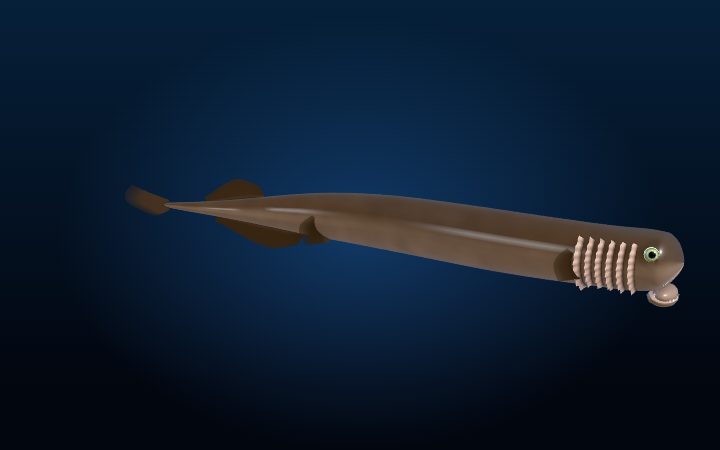
A primitive shark with a long, eel-like body and six pairs of frilly gills. Its roughly 300 needle-like teeth, each with three prongs, sit in rows and can hold even slippery squid.
Did you know?
Its gestation is estimated at 1 to 3.5 years, and some scientists think it's the longest of any vertebrate (estimates differ between studies).
What it looks like
A long, thin, eel-like brown body, six pairs of frilled gills behind the head (the first pair wraps around the throat), a wide mouth at the very tip of the head, and fins crowded toward the rear of the body
More about this creature
Where and how deep it lives
The frilled shark has a wide but patchy range in the Atlantic, the Pacific and the western Indian Ocean off South Africa. It is known from northern Norway to northern Namibia, from Japan to New Zealand, and from southern California to northern Chile, while the western Atlantic has only three records. It lives on the outer continental shelf and slope and is usually caught at about 120–1,280 m.
In Suruga Bay, Japan, it is most common at 50–200 m, moving into deeper, cooler water from August to November, when the layer at 100 m warms above 15 °C. It has been caught as deep as 1,570 m but usually stays above 1,000 m.
Food and hunting
About 60% of its diet is squid; it also eats other cephalopods, smaller sharks, bony fish and nudibranchs. Its jaws let it swallow prey more than half its own length.
One hypothesis is that it curls its eel-like body and braces its rear fins against the water to lunge forward suddenly. Because its jaws attach directly to the skull behind the eyes, its bite is fairly weak. Captive observations suggest it hunts with its mouth open, perhaps using the contrast of its white teeth in the dark as a lure.
Body and adaptations
Males reach about 1.7 m and females about 2.0 m, and the skin is a uniform dark brown or grey. The dorsal fin sits far back, almost opposite the anal fin, and the pelvic and anal fins are also crowded toward the tail. A large liver full of low-density oil provides buoyancy. Its lateral line is a primitive open groove, with sensory hair cells exposed to the surrounding water.
Life cycle and behaviour
Males mature at about 1.0–1.2 m and females at about 1.3–1.5 m. There is no fixed breeding season, and females ovulate about every two weeks. Embryos live on yolk alone, growing about 1.4 cm a month, and litters of 2–15 pups (about six on average) are born at roughly 40–60 cm.
Humans and conservation
Samuel Garman described the species in 1884 from a 1.5 m female caught in Sagami Bay, Japan. Its primitive features have earned it the label 'living fossil', and in 2009 a second living species, the southern African frilled shark (C. africana), was described.
It is mostly caught as bycatch in trawls, gillnets and longlines and is sometimes used for food or fishmeal. It isn't dangerous to people, though its teeth are sharp enough to cut the hands of scientists examining its mouth. The IUCN Red List rates it Least Concern.
Sources & further reading
- Chlamydoselachus anguineus — FishBase www.fishbase.se
- Frilled shark — Wikipedia en.wikipedia.org