Goblin shark
Scientific name: Mitsukurina owstoni
The Goblin shark is a sea creature that lives in open water at depths of about 30–1,300 m, growing to about 6 m. In Abyss Dive you meet it at 550 m, in the Twilight Zone (Mesopelagic).
- Depth range
- about 30–1,300 m
- Max size
- about 6 m
- Zone in this guide
- Twilight Zone 200–1,000 m
- Bioluminescence
- No
- Habitat
- Open water (swimming)
- Depth in the 3D dive
- 550 m
What is it?
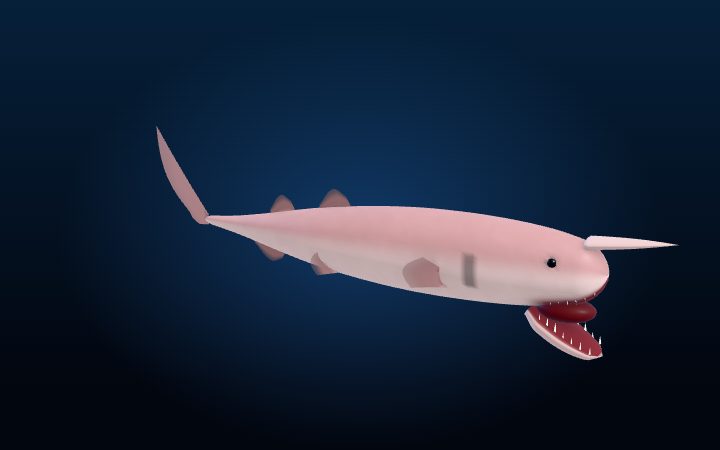
A deep-sea shark with a long, flat snout that juts out in front and pink skin. Blood vessels show through the translucent skin, which is what makes it look pink. It lives mostly at about 270–960 m.
Did you know?
When it bites, its whole jaw shoots forward like a slingshot, then snaps back.
What it looks like
A long, flat, blade-like snout extending ahead of the head, a jaw of spiky teeth that thrusts downward, a soft pinkish body, and a very long upper tail lobe
More about this creature
Where and how deep it lives
The goblin shark has been recorded in all three major oceans, but only patchily. It lives on upper continental slopes, in submarine canyons and around seamounts; it has been caught as deep as 1,300 m and sighted at about 2,000 m. Off southern Japan, juveniles stay shallower than adults, at about 100–350 m. The only eastern Pacific record is a single fish from southern California.
Food and hunting
Known prey includes rattails, dragonfishes, cephalopods and crustaceans. Electroreceptors called ampullae of Lorenzini on the underside of its long snout pick up the weak electric fields of hidden prey.
Feeding strikes were first filmed in 2008 and 2011. Analysis showed the jaws shoot out at up to about 3.1 m/s and protrude roughly 2.1–9.5 times farther than those of other sharks, driven by elastic ligaments that act like a catapult.
Body and adaptations
Its slender, flabby body and small fins point to a sluggish ambush hunter rather than a fast chaser. An oily liver keeps it near neutral buoyancy, so it can drift toward prey with barely a movement. Its eyes are small and lack the protective nictitating membrane, and it has 35–53 rows of teeth in the upper jaw and 31–62 in the lower.
Adults are usually 3–4 m long. One fish caught in 2000 was estimated at 5.4–6.2 m, and a 2019 study suggested a maximum of about 7 m. A pregnant 4.7 m female landed in Taiwan in 2023 weighed about 800 kg and carried six pups.
Life cycle and behaviour
Mating has never been observed. Young develop inside the mother, apparently feeding on unfertilized eggs once their yolk runs out. Newborns are probably about 82 cm long, and males mature at about 2.6 m. One estimate puts male maturity at around 16 years and lifespan at up to 60 years. Blue sharks may prey on goblin sharks.
Humans and conservation
David Starr Jordan described the species in 1898 from a 107 cm immature male caught in Sagami Bay near Yokohama. Its scientific name honors Alan Owston, who obtained the specimen, and Japanese zoologist Kakichi Mitsukuri, who passed it to Jordan; the English name translates the Japanese tenguzame. It is the only living member of the family Mitsukurinidae, a lineage about 125 million years old.
Around 30 are caught each year as bycatch off southern Japan, and in April 2003 more than 100 were caught off northwestern Taiwan after a major earthquake. Captive specimens have survived only a week or two days. Because of its wide range and low catch rates, the IUCN Red List rates it Least Concern, and it is harmless to people.
Sources & further reading
- Mitsukurina owstoni — FishBase www.fishbase.se
- Goblin shark — Wikipedia en.wikipedia.org