Lophelia (Cold-water coral)
Scientific name: Desmophyllum pertusum
The Lophelia (Cold-water coral) is a sea creature that lives near the seafloor at depths of about 80–3,000 m, growing to about 2 m. In Abyss Dive you meet it at 760 m, in the Twilight Zone (Mesopelagic).
- Depth range
- about 80–3,000 m
- Max size
- about 2 m
- Zone in this guide
- Twilight Zone 200–1,000 m
- Bioluminescence
- No
- Habitat
- Near the seafloor
- Depth in the 3D dive
- 760 m
What is it?
A reef-building coral of cold, sunless seas. Unlike tropical corals, it has no symbiotic algae in its body, so it catches drifting food with its tentacles. It mostly lives at 200–1,000 m, and the Røst Reef off Norway is about 35 km long.
Did you know?
It grows about 1 mm a year. Some reefs are around 40,000 years old, and a single living thicket can be 1,000 years old.
What it looks like
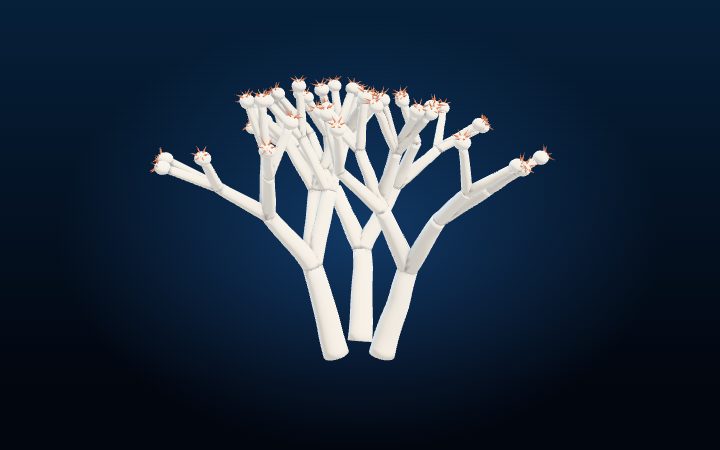
A branching thicket of white-to-orange twigs forking upward from the bottom, with a cup-shaped polyp (up to 16 translucent tentacles) at the tip of each branch
More about this creature
Where and how deep it lives
This coral is most widespread in the deep North Atlantic and also grows in the Caribbean and in the Alboran Sea at the western end of the Mediterranean. It has been reported from the waters of Norway, the UK, Ireland, Portugal, Italy, Greece, Canada, the US, Brazil and other countries. It lives at about 4–12 °C and has been recorded from 80 m to more than 3,000 m deep.
A NOAA-partnered study publicized in January 2024 mapped 83,908 coral mounds, built largely by this species, on the Blake Plateau off the southeastern US. The coral province stretches up to about 500 km long and 110 km wide and covers about 6.4 million acres (roughly 26,000 km²), making it the largest deep-sea coral reef habitat known. Most of it lies at 200–1,000 m, in water averaging about 4 °C.
Food and hunting
The polyps extend their tentacles to strain plankton from the water and can swallow particles up to 2 cm across. It is an opportunistic feeder that also takes broken-down organic matter; the organic material that sinks after spring plankton blooms at the surface is its main supply of nutrients.
Body and adaptations
It is a colonial coral with a calcium carbonate skeleton, and living colonies range from white to orange-red. Each polyp has up to 16 tentacles and is translucent pink, yellow or white. Unlike most tropical corals, its polyps aren't linked by living tissue. The reefs it builds can stand up to 35 m high.
Life cycle and behaviour
The sexes are separate, and colonies release sperm or eggs into the sea. The larvae don't feed; they live on yolk reserves and drift with the plankton for weeks before settling. Colonies also reproduce asexually by budding and fragmentation.
The reefs shelter fish such as conger eels, sharks, groupers, hake, hatchetfish and lanternfish, along with brittle stars, molluscs, amphipods and crabs. The polychaete worm Eunice norvegica lives in partnership with the coral, strengthening and cleaning the reef.
Humans and conservation
Bottom trawling is the main threat: scientists estimate it has damaged or destroyed 30–50% of the coral area on the Norwegian shelf. Norway banned bottom trawling over about 1,000 km² around the Sula Reef in 1999, about 600 km² in 2000 and about 300 km² around the Røst Reef in 2002. Warming water also threatens the coral through metabolic stress.
It has been listed on CITES Appendix II since January 1990, and the OSPAR Convention recognizes its reefs as a threatened habitat. Colonies have even been found on 13 of 14 North Sea oil installations examined. Long known as Lophelia pertusa, it is now placed in Desmophyllum as D. pertusum, the name under which the IUCN Red List assesses it as Vulnerable.