Glass octopus
Scientific name: Vitreledonella richardi
The Glass octopus is a sea creature that lives in open water at depths of about 200–1,000 m, growing to about 45 cm. In Abyss Dive you meet it at 580 m, in the Twilight Zone (Mesopelagic).
- Depth range
- about 200–1,000 m
- Max size
- about 45 cm
- Zone in this guide
- Twilight Zone 200–1,000 m
- Bioluminescence
- No
- Habitat
- Open water (swimming)
- Depth in the 3D dive
- 580 m
What is it?
An octopus with a transparent, jelly-like body in which little more than the eyes and organs are visible. It lives where almost no sunlight reaches. Young ones seem to live deeper and move up as they grow.
Did you know?
Seen from the side, its eyes are rectangular. This is thought to be camouflage that makes the shadow of the eyes as small as possible when seen from below.
What it looks like
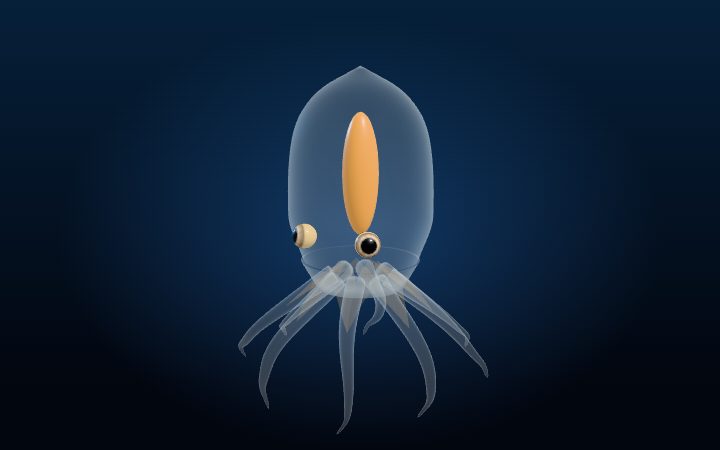
A nearly colorless, transparent, jelly-like mantle with eight short arms, only a long orange digestive gland in the middle showing through, and small eyes that look rectangular from the side
More about this creature
Where and how deep it lives
The glass octopus is found in tropical and subtropical seas worldwide, though not in polar waters. It lives over deep water beyond the continental shelf, from near the surface to at least 1,000 m, and is thought to be most common around islands and seamounts.
Body and adaptations
The mantle reaches about 11 cm and the total length, arms included, about 45 cm. The body is gelatinous, transparent and almost colorless, so from outside you can see little more than the optic nerves, eyeballs and digestive tract. The upper three pairs of arms are about as long as the mantle in juveniles but grow to two or three times its length in adults.
Its beak is weak and poorly developed, suggesting it eats soft-bodied prey, at least when young. Its actual diet is barely documented.
Life cycle and behaviour
Unlike most octopuses, which attach their eggs to rocks, the female keeps hundreds of eggs, each about 4 mm long, on her body until the young emerge. Newborns have mantles only about 2.2 mm long, and the mother dies soon after they are born.
In males the third left arm is modified to transfer sperm and can detach to do so. Submersible video suggests the male wraps the female in the webbing between his arms while mating.
Humans and conservation
French zoologist Louis Joubin described the species in 1918. Because it is so rarely seen alive, footage taken in June 2021 by the Schmidt Ocean Institute's research vessel Falkor, near a reef complex in the central Pacific's Phoenix Islands at nearly half a mile down, drew wide attention. That 34-day expedition mapped more than 30,000 km² of seafloor and livestreamed its dives. The species has also been found in the stomachs of northern bottlenose whales, and the IUCN Red List rates it Least Concern (2014 assessment).
Sources & further reading
- Glass octopus — Wikipedia en.wikipedia.org
- Vitreledonella richardi — SeaLifeBase www.sealifebase.se
- 'Glass octopus' sighted by marine scientists in Pacific Ocean — KTVU/FOX (2021) ktvu.com