Strawberry squid (Cock-eyed squid)
Scientific name: Histioteuthis heteropsis
The Strawberry squid (Cock-eyed squid) is a bioluminescent (light-making) sea creature that lives in open water at depths of about 200–1,000 m, growing to about 20 cm. In Abyss Dive you meet it at 540 m, in the Twilight Zone (Mesopelagic).
- Depth range
- about 200–1,000 m
- Max size
- about 20 cm
- Zone in this guide
- Twilight Zone 200–1,000 m
- Bioluminescence
- Yes
- Habitat
- Open water (swimming)
- Depth in the 3D dive
- 540 m
What is it?
A small squid with red skin studded with seed-like photophores, so it looks like a strawberry. Blue light from the organs on its underside blends with the light from above and erases its shadow.
Did you know?
Its two eyes are different sizes. The large yellow left eye looks up for faint sunlight, while the small right eye looks down for bioluminescence.
What it looks like
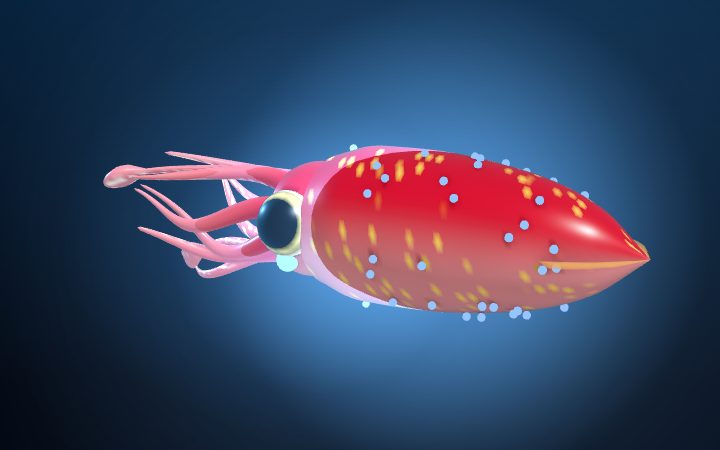
A short, red, conical mantle with stout arms, small light spots set like seeds all over the body, and a large, bulging yellow left eye with a much smaller right eye
More about this creature
Where and how deep it lives
It lives mainly in the California and Humboldt currents of the eastern Pacific and avoids waters close to the equator. There is no evidence of long horizontal migrations. A 1975 survey caught most individuals at about 500–700 m by day and 300–400 m by night, indicating that it rises toward the surface after dark.
Food and hunting
Stomach contents show it eats fish, crustaceans and smaller squids. It strikes with its two long tentacles, holds the prey with its arms and bites off the soft parts with its beak.
Body and adaptations
Mature males have mantles averaging about 5.4–8.9 cm, and total length is usually about 20 cm. The skin is a purplish red, and the small light organs are densest near the head, thinning out toward the rear. Hatchlings have two identical eyes; as they grow, the left eye becomes more than twice the size of the right and develops a yellow lens.
In a study published in 2017, Duke University researchers analyzed 152 sightings in roughly 30 years of MBARI ROV footage. The squid drifted in a near-vertical, head-down, tail-up posture, with the big eye always facing up and the small eye facing down. Their models showed that slightly enlarging the upward eye greatly boosts its sensitivity, while enlarging the downward eye barely helps.
Life cycle and behaviour
It is a slow-moving squid that inks only when closely approached or touched, usually releasing a dense blob of ink roughly its own shape and size (a pseudomorph) as a decoy.
Instead of a modified mating arm, males have a penis that grows until it can extend beyond the mantle cavity, and they store sperm packets in a looped Needham's sac. Females have a single ovary. Where and how mating and spawning happen is still largely unknown.
Humans and conservation
S. Stillman Berry described the species in 1913. It is an important food for tuna, porpoises, blue sharks, sperm whales, elephant seals and albatrosses. The Monterey Bay Aquarium put it on public display for the first time in June 2014. The IUCN Red List (2010 assessment) rates it Least Concern because of its large range, though no population data exist.
Sources & further reading
- Histioteuthis heteropsis — Wikipedia en.wikipedia.org
- Mismatched eyes help squid survive ocean's twilight zone — Duke Today (2017) today.duke.edu