Pacific hagfish
Scientific name: Eptatretus stoutii
The Pacific hagfish is a sea creature that lives near the seafloor at depths of about 16–966 m, growing to about 63 cm. In Abyss Dive you meet it at 820 m, in the Twilight Zone (Mesopelagic).
- Depth range
- about 16–966 m
- Max size
- about 63 cm
- Zone in this guide
- Twilight Zone 200–1,000 m
- Bioluminescence
- No
- Habitat
- Near the seafloor
- Depth in the 3D dive
- 820 m
What is it?
A primitive jawless fish that feeds near the muddy bottom, mostly on dead animals that have sunk. It looks like an eel but isn't closely related to one.
Did you know?
When harassed, it releases large amounts of sticky slime that clogs the attacker's gills.
What it looks like
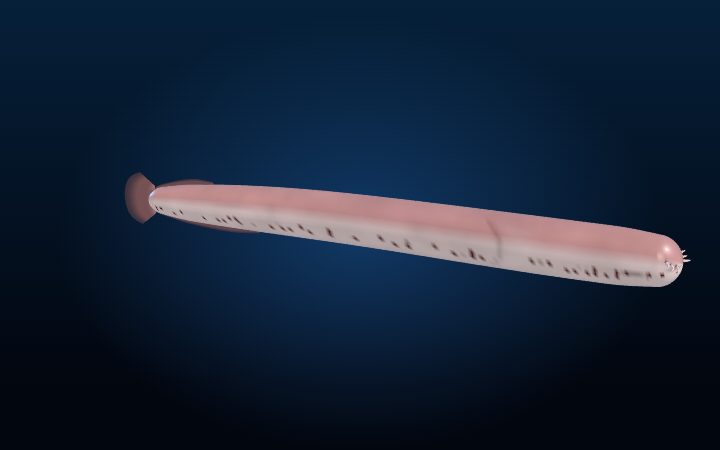
A long, eel-like pinkish-brown body with almost no fins, eyes buried beneath the skin and hard to see, several short barbels around the mouth, and a row of slime pores along the flanks
More about this creature
Where and how deep it lives
The Pacific hagfish ranges along the northeastern Pacific from southeast Alaska to central Baja California, living on fine silt and clay bottoms at about 16–966 m. It stays in one area rather than migrating and tolerates low-oxygen conditions.
Food and hunting
It probably eats polychaete worms and other seafloor invertebrates, and it burrows into dead, dying or trapped large fish through the mouth or anus to eat their guts and flesh. By stripping fish caught on fixed gear, it can sharply reduce fishermen's catches. It ties its body into overhand or figure-eight knots and uses the leverage to tear off flesh, and the same trick scrapes slime off its body.
Body and adaptations
It has no jaws: eight barbels surround its sucker-like mouth, with a single nostril above it. Its eyes are simple light-sensing spots, so it is functionally blind, and the transparent patches of skin over them look like white dots. It has no true vertebrae and 10–14 gill pores.
Its skin hangs loosely, so internal organs can slip away from a puncture, and it can absorb amino acids directly through the skin. Relative to its size it holds about twice as much blood as a mammal, nearly a third of it in a space under the skin, which lets it squeeze through gaps less than half its body width. It has one of the lowest metabolic rates of any fish, and emptied slime glands take about 24–28 days to refill.
Life cycle and behaviour
The sex ratio is roughly even, and females lay an average of about 28 eggs, each about 5 mm across. A spawning cycle can take two to three years, and the young hatch as miniature adults with no larval stage. Juveniles may carry both male and female gonad tissue.
It grows slowly, maturing at 7–12 years and living an estimated 25–50 years, and adult females tend to be larger than males. Spiny dogfish and marine mammals are among its natural predators.
Humans and conservation
The US West Coast hagfish fishery began in the late 1980s. At first it targeted skin for 'eel skin' wallets, belts and similar goods, many of which are in fact hagfish leather. Hagfish farther south have more and larger slime pores, which made for poor leather, so the southern fisheries didn't last.
Today hagfish are caught in baited pots and sold mostly live, fresh or frozen as seafood, with South Korea the main market. California and Oregon manage their fisheries separately, while Washington's is still experimental, collecting data to see whether the population can support it. Hagfish are also collected for research on their primitive metabolism, and the IUCN Red List lists the species as Data Deficient (2009 assessment).
Sources & further reading
- Eptatretus stoutii — FishBase www.fishbase.se
- Pacific hagfish — Wikipedia en.wikipedia.org
- Pacific Hagfish — Discover West Coast Seafood (UC Santa Barbara) discoverwcseafood.msi.ucsb.edu
- Your car has just been crushed by hagfish: FAQ — Southern Fried Science www.southernfriedscience.com